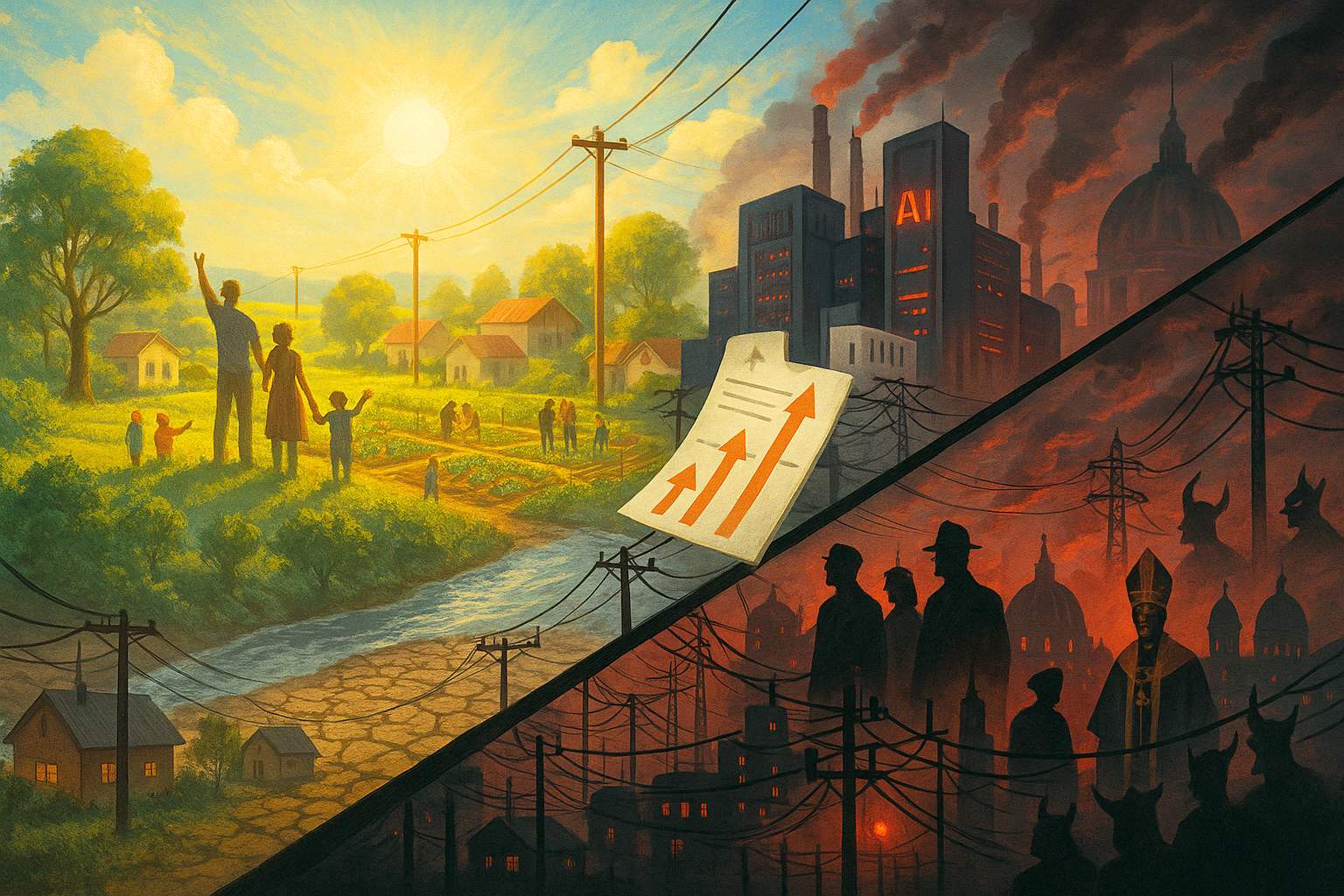
PEPCO power blips/flashes becoming more common in Darnestown is consistent with a grid under increasing instability and stress.
PEPCO power in Darnestown has entered a new and troubling phase. Over the past several months, around 2026, brief power blips, flickers, and flashes have become increasingly common.
That is notable because, for roughly the previous five years, PEPCO service in and around Darnestown, Maryland had been relatively stable — even excellent. Before that, however, going back decades, outages were agonizingly routine: sometimes only minutes, often hours, occasionally many hours, and a few times lasting days. Throughout that long period, outages occurred multiple times per month on average.
Conditions became so bad that political pressure eventually forced intervention. The result was what many residents experienced as a “tree holocaust”: numerous old, historical, and significant trees were cut back or removed from around power lines. This caused understandable anger from people who valued the trees — especially those not living in the foliage-heavy areas where power failures had become essentially constant.
For those of us in the outage-prone zones, though, the tree clearing marked a real turning point. Reliability improved dramatically afterward. That is why the recent return of frequent flickers and power flashes is so concerning: it suggests a different kind of instability may now be emerging, not simply the old tree-contact problem. It seems most likely that Datacenters, so many so near and with many more coming, are directly and indirectly causal.
Electrical Gluttony. Water Consumption. Noise Pollution. Ground Vibration. Powerline Harmonics. Exploring the Web of Land-Grabby, Depopulative, Anti-Meat, Anti-Farm and Anti-Human Incessant Toxic Badness.
Covering every known aspect of Datacenters, including the paranormal.
Sourced Series deeply explores the Many Serious Ill-Effects of Datacenters.
Every statement is sourced by scientific studies, published anecdotes, harmed victims.
Learn from others’ mistakes, or suffer similarly.
“A 2026 power-engineering study found that hyperscale data centers behave not merely as electrical loads, but as vast power-electronics systems whose rapidly fluctuating server demands can excite grid oscillations and propagate disturbances across interconnected networks. Far from a fringe “dirty electricity” claim, the research suggests data centers may interact with the power grid in ways fundamentally different from traditional industrial facilities, raising serious new concerns about resonance, stability, reliability.”
When electric utilities shift from public-service infrastructure planning toward investor-return, competitive-market, and large-load growth priorities, the system’s margin for ordinary residential reliability shrinks. Residents experience that as more flickers, brownouts, momentary outages, longer restoration pressure, and higher bills — while massive buyers like datacenters reshape grid spending and service priorities.
For Darnestown/PEPCO specifically, the likely connective frame is:
- Local symptom: repeated blips/flashes suggest voltage instability, feeder switching, protective equipment trips/reclosers, overloaded circuits, tree/contact faults, or upstream transmission/distribution stress.
- System trend: utilities now face rapid load growth from datacenters, electrification, and large commercial demand.
- Market effect: privatized/investor-owned utilities recover infrastructure spending through rates, while prioritizing projects that serve major load growth.
- Resident outcome: households pay more but may not receive better reliability; instead, they absorb instability during the transition.
- Political/economic critique: “public utility” logic becomes “serve profitable growth first, socialize grid costs second.”
The increasing PEPCO blips and flashes in Darnestown are the household-level symptom of a broader electric-grid disorder: a system once justified as a public utility is being reorganized around investor returns, massive new loads, and market-priced scarcity. Whether each flicker comes from a feeder fault, switching event, vegetation contact, or overloaded equipment, the pattern fits a grid whose reserve margins and maintenance priorities are being squeezed. Residents see instability and rising bills, while datacenters and other bulk purchasers drive new transmission, generation, and capacity decisions. That is privatization’s quiet failure mode: the public still pays for the grid, but the grid is increasingly planned around the highest-value customers rather than ordinary service reliability.
For evidence, pair your local observation with documented broader facts:
- PJM has warned about reliability pressure from large loads/datacenters.
- DOE/PJM emergency orders now contemplate curtailing datacenters before rolling blackouts.
- Regulators in VA/OH/GA/OR/PA are debating how to prevent datacenter costs from being shifted to ordinary ratepayers.
- Deregulated markets like California/Texas show how market design can produce both higher prices and reliability failures.
10 sources supporting the broader connection between residential reliability stress, datacenter/large-load demand, deregulation/market forces, and ratepayer burden:
- PJM emergency authority to curtail datacenters before rolling blackouts — Utility Dive
https://www.utilitydive.com/news/pjm-doe-emergency-order-curtail-data-centers/820571/ - Big Tech datacenters may face grid cutoffs during power crises — AP
https://apnews.com/article/big-tech-data-centers-electricity-energy-power-texas-pennsylvani
a-46b42f141d0301d4c59314cc90e3eab5 - Datacenter demand driving reliability and blackout concerns in PJM — NRDC
https://www.nrdc.org/press-releases/rising-demand-data-centers-driving-reliability-cost-con
cerns - NERC warning on emerging large-load risks to grid reliability — NERC PDF
https://www.nerc.com/globalassets/who-we-are/standing-committees/rstc/whitepaper-characteri
stics-and-risks-of-emerging-large-loads.pdf - Sudden datacenter load losses prompt NERC reliability alert — Utility Dive
https://www.utilitydive.com/news/data-center-load-disruptions-nerc-alert-recommendations/81
8036/ - Dominion/Virginia datacenter costs shifting toward ordinary customers — Virginia Mercury
https://virginiamercury.com/2024/11/26/under-pressure-from-the-scc-dominion-reveals-the-tru
e-cost-of-data-centers/ - Harvard report: ratepayers paying for Big Tech power infrastructure — Harvard EELP PDF
https://eelp.law.harvard.edu/wp-content/uploads/2025/03/Harvard-ELI-Extracting-Profits-from
-the-Public.pdf - AEP Ohio datacenter tariff designed to protect ratepayers from grid-expansion costs — POWER
Magazine
https://www.powermag.com/regulator-approves-aep-ohios-landmark-data-center-tariff/ - Electricity deregulation produced higher consumer prices via market power — MIT CEEPR
https://ceepr.mit.edu/deregulation-market-power-and-prices-evidence-from-the-electricity-se
ctor/ - Texas deregulated/isolated grid and blackout failure — Baker Institute
https://www.bakerinstitute.org/research/what-happened-texas-understanding-february-2021-bl
ackouts
PEPCO blips in Darnestown, MD are the symptom; these sources support the broader systemic pattern:
Official / near-official docs:
- Maryland PSC — Pepco rate case order, Case 9702
PSC approved only part of Pepco’s requested rate increase.
https://psc.maryland.gov/wp-content/uploads/Order-No.-91181-Order-on-Application-for-a-Mult
i-Year-Rate-Plan-9702.pdf - Maryland PSC press release — Pepco rate increase decision
Pepco requested up to $213.6M over multi-year plan; PSC approved $44.6M for one year.
https://www.psc.state.md.us/wp-content/uploads/MD-PSC-Decision-in-Pepco-Rate-Case-9702_0610
24.pdf - Maryland PSC — Electric Reliability Performance Reports order
Official reliability reporting under Maryland Electricity Service Quality and Reliability Act / COMAR.
https://psc.maryland.gov/wp-content/uploads/Order-No.-90782-2022-Electric-Reliability-Perfo
rmance-Reports-Order-1.pdf - Maryland COMAR — System-wide reliability standards
Utilities must track/report SAIDI, SAIFI, CAIDI reliability metrics.
https://www.law.cornell.edu/regulations/maryland/COMAR-20-50-12-02 - Maryland PSC — Pepco Multi-Year Plan Final Reconciliation – Includes reliability, capital projects, feeders, vegetation management, corrective maintenance.
https://psc.maryland.gov/wp-content/uploads/2026/03/Order_Pepco-MYP-Final-Reconciliation-96
55.pdf - Pepco Maryland Supplier Tariff
Official Pepco tariff showing retail supplier/PJM coordination under Maryland’s competitive supply structure.
https://www.pepco.com/cdn/assets/v3/assets/bltbb7c204688a1a6a8/blt8d284546a2ec90cd/6687db00
9964731dae53e697/Pepco_MD_CURRENT_Clean_Supplier_Tariff_updates_effective_070124.pdf - Maryland OPC FERC protest — PJM transmission costs/data centers
Maryland Office of People’s Counsel argues Maryland customers face costs from out-of-state data center load growth.
https://opc.maryland.gov/Portals/0/Files/Publications/Others/MdOPC%20Protest%20and%20Affida
vit%20of%20R.%20Nelson%20ER24-843%2002-09-24%20(1).pdf - Maryland OPC complaint — PJM RTEP transmission cost allocation
Official consumer-advocate complaint over billions in transmission costs and Maryland customer allocation.
https://opc.maryland.gov/Portals/0/Files/Publications/Others/20260507%20-%20RTEP%20complain
t%20-%20FINAL%20932.pdf - Maryland OPC notice — nearly $800M data-center-related PJM cost concern
Official OPC public notice about Maryland customers being charged for out-of-state data center growth.
https://content.govdelivery.com/accounts/MDOPC/bulletins/3de09c9 - Pepco/Delmarva official testimony on Maryland SB596 large-load customers
Defines large-load customers as 25MW+ and discusses expedited interconnection/demand response framework.
https://mgaleg.maryland.gov/cmte_testimony/2026/eee/15c6A77CpzzfMQLge-yNFvqVV_4935K4_.pdf
These documents don’t prove each Darnestown blip’s cause, but they indicate Pepco rate pressure, reliability standards, capital/reliability programs, competitive supply/PJM structure, and nearby/connected/impactful large-load/datacenter cost-allocation concerns affecting Maryland customers.