“Many residents say they learned about nearby developments only after construction had already begun. Their reports describe concerns about water consumption, electricity demand, constant mechanical noise, land use, electronic waste, and pressure on local infrastructure.”
Electrical Gluttony. Water Consumption. Noise Pollution. Ground Vibration. Powerline Harmonics. Exploring the Web of Land-Grabby, Depopulative, Anti-Meat, Anti-Farm and Anti-Human Incessant Toxic Badness.
Covering every known aspect of Datacenters, including the paranormal.
Sourced Series deeply explores the Many Serious Ill-Effects of Datacenters.
Every statement is sourced by scientific studies, published anecdotes, harmed victims.
Learn from others’ mistakes, or suffer similarly.
“A 2026 power-engineering study found that hyperscale data centers behave not merely as electrical loads, but as vast power-electronics systems whose rapidly fluctuating server demands can excite grid oscillations and propagate disturbances across interconnected networks. Far from a fringe “dirty electricity” claim, the research suggests data centers may interact with the power grid in ways fundamentally different from traditional industrial facilities, raising serious new concerns about resonance, stability, reliability.”
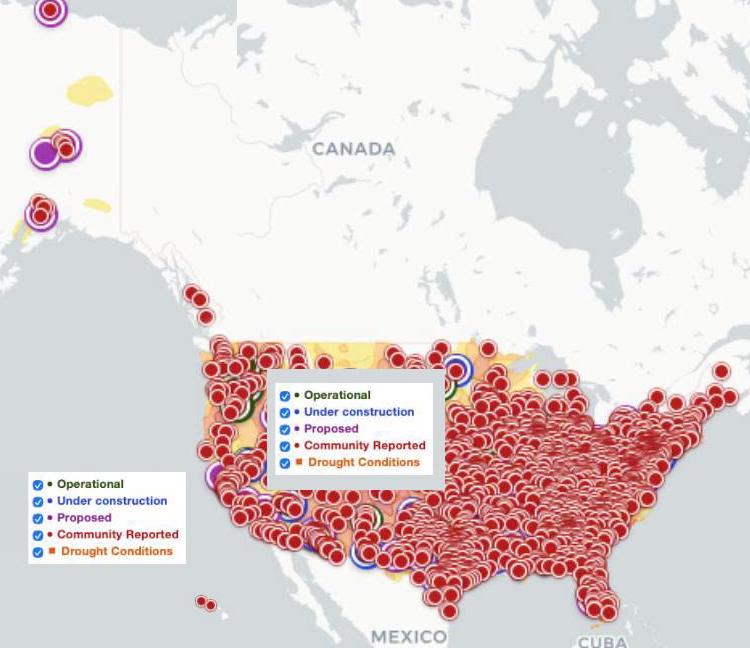
Erin Brockovich’s new data center map crashed twice in 72 hours.
The environmental advocate says she woke up one morning to dozens of messages from residents from one Louisiana community describing similar problems linked to data centers near their homes. When she began investigating, she struggled to get clear answers about the projects.
That prompted her to launch a public map where Americans could report operational, proposed, and under-construction data centers in their communities.
The response was immediate. Brockovich says the website crashed twice within its first 72 hours, revealing that the complaints were not limited to one town, one aquifer, or one project.
The map has since collected more than 8,000 community-reported locations.
Many residents say they learned about nearby developments only after construction had already begun. Their reports describe concerns about water consumption, electricity demand, constant mechanical noise, land use, electronic waste, and pressure on local infrastructure.
The controversy highlights a less visible side of the artificial intelligence boom. AI may feel entirely digital, but it relies on enormous physical facilities filled with servers that produce heat and operate around the clock.
Keeping those machines running requires electricity, cooling systems, transmission infrastructure, and, in some cases, large quantities of water. These demands can become especially contentious in communities already facing strained power grids or limited water supplies.
Data center developers argue that the facilities can bring construction investment, tax revenue, and new infrastructure. Brockovich’s project is focused on a different question: whether residents are being informed early enough to understand and influence what is being built around them.
Learn more:
“Erin Brockovich Explains Why She Started Mapping New Data Center Concerns.” Newsweek
Over three hundred thousand toxic RF / microwave / cell-phone towers were erected in USA in the 20 or so years since inception until enough people fell ill or at least experienced symptoms of radio-frequency electromagnetic radiation poisoning and sickness. https://antennasearch.com can show the monsters right in your own backyard.