It likely deserves a New Word already; I propose: SHTASTROPHE – 900 million gallons of raw sewage spewed to-date with no end in sight in an unimaginably damaging catatrophe, the largest ever in American (and possibly world) history. It’s already 90 times worse than Exxon Valdez. Most local residents have never even heard not one peep about it!
Assuming you mean the Potomac Interceptor (PI) (the large sanitary sewer line tied to the recent Potomac sewage incident), here are the direct answers.
Who owns it?
Operationally, the PI system is under DC Water (legal name: District of Columbia Water and Sewer Authority / DCWASA). The project documents state DCWASA is responsible for operation/maintenance of the PI except the Maryland Upper Potomac Interceptor (MUPI) segment, which is operated/maintained by WSSC Water.
Where does it come from and go to, exactly?
Public engineering docs describe this flow path:
- Wastewater originates in service areas near Dulles Airport (plus Fairfax, Loudoun, Montgomery, DC, and certain local jurisdictions/entities feeding in).
- It moves through the PI system segments (PI trunk / MUPI / UPI / UPIRS).
- It reaches the Potomac Pumping Station in Washington, DC.
- From there it is pumped to Blue Plains Advanced Wastewater Treatment Plant.
- After treatment, discharge is to the Potomac.
Segment-level detail in the EA: PI trunk includes Sugarland Run, Difficult Run, and Upper Maryland Spur; MUPI feeds UPI at the DC line; UPI feeds UPIRS; UPIRS goes to Potomac Pump Station.
Under-river detail: the PI has two river tunnel crossings, with the longest noted as about 3,000 ft beneath the Potomac near Great Falls/Washington Aqueduct area. (DC Water)
When was it built?
- Authorized by Public Law 86-515 on June 12, 1960.
- DC Water materials indicate first flows began in 1964 (i.e., construction/commissioning in the 1960s). (DC Water)
Who has the engineering blueprints?
For current “record” drawings and official engineering files:
- DC Water: their CAD/records standards state final as-built drawings are submitted to DC Water, then linked in GIS and stored in their enterprise document system (OpenText/Livelink) for long-term records. (DC Water)
- WSSC Water (for its MUPI/related assets): WSSC’s WERI system maintains scanned engineering documents/plans/finals and GIS layers, with controlled access. (wsscwater.com)
Historically, legacy design reports also exist from engineering consultants (e.g., Burns & McDonnell 1961 reference in PI EA), but official as-built/control copies are held by the utilities above.
(Past chat)(Past chat)(Past chat)(Past chat)
Perfect — here’s the segment-level chain in upstream-to-downstream order.
Potomac Interceptor flow chain (as published)
Branch A (Virginia / Dulles side):
Areas near Dulles feed the PI main trunk (subsystems: Difficult Run Extension (200 series), Sugarland Run Extension (300 series), Upper Maryland Spur (400 series)). (DC Water)
Branch B (Montgomery County side):
Montgomery County wastewater enters the MUPI (3000 series), which feeds the UPI (2900 series) at the DC line.
Convergence in DC:
The UPI conveys flow to UPIRS (1900 series), and UPIRS carries flow (including PI main trunk contributions and other service connections) to the Potomac Pump Station in Washington, DC.
Final destination:
From Potomac Pump Station, flow is sent to Blue Plains Advanced Wastewater Treatment Plant, then discharged to the Potomac after treatment. (DC Water)
Ownership / control (operational)
- DC Water operates and maintains the PI system overall.
- Exception: MUPI is operated/maintained by WSSC Water.
Build era
- Authorized by Public Law 86-515 (June 12, 1960).
- First sewage flows are documented as beginning in 1964. (DC Water)
Physical scale markers
- System is shown as 54+ miles, with 11 tunnel sections and 2 river tunnel crossings in current DC Water fact material.
- Great Falls crossing is identified as a 3,000-foot segment and 78-inch sewer line. (DC Water)
Who has the blueprints / engineering records
- DC Water holds modern record-drawing submissions in its enterprise records workflow (GIS updates + OpenText/Livelink archival).
- WSSC Water holds its engineering records via WERI (plans/finals/house connections/200’ sheets, etc.). (wsscwater.com)
- Public-facing DC Water request channels provide GIS/counter-map infrastructure info (pipe location/structures), while full detailed plan access is handled through utility records processes. (DC Water)
Next pass is a records-request packet (DC Water + WSSC) specifically asking for:
- PI/MUPI/UPI/UPIRS as-builts,
- plan-and-profile sheets by structure series,
- latest rehab design set for the Potomac River crossing segment.
See also
“The defecant is so thick in the air that you can taste it on your tongue.” – NBC channel 4 newscaster
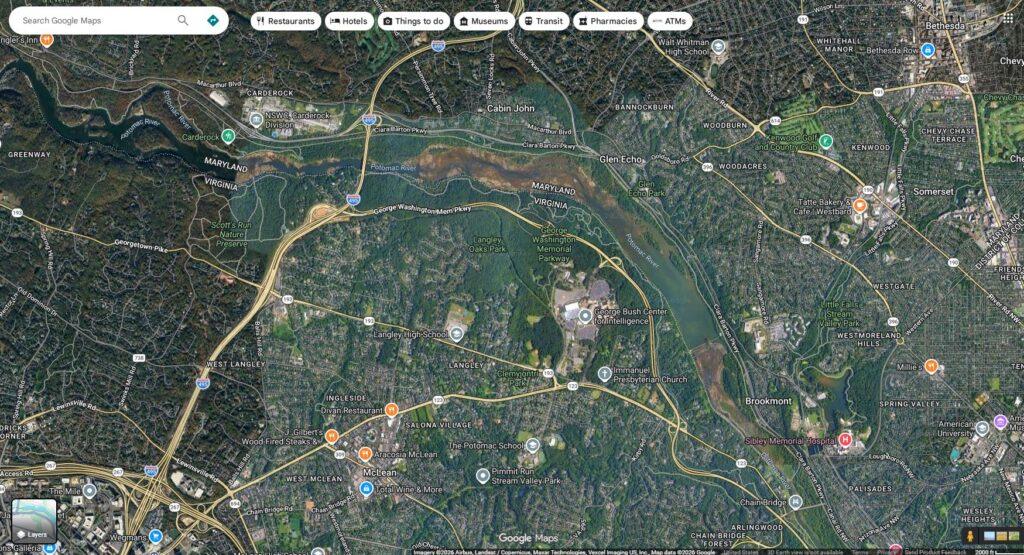
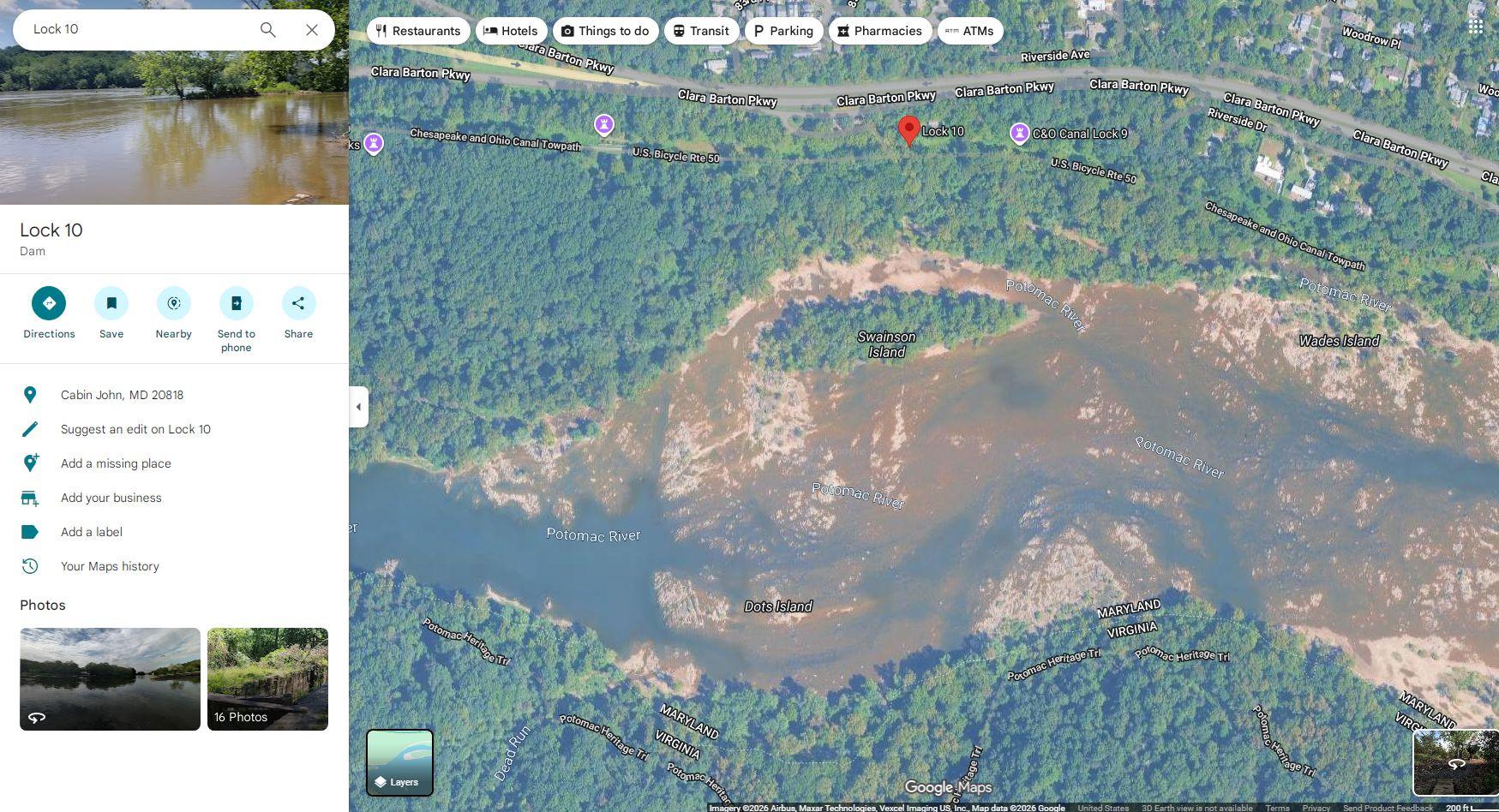
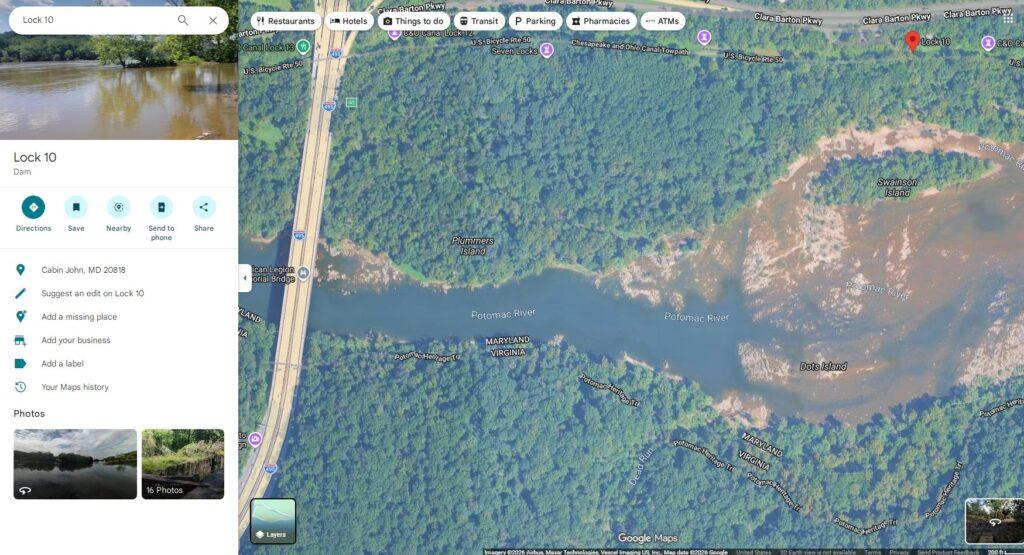
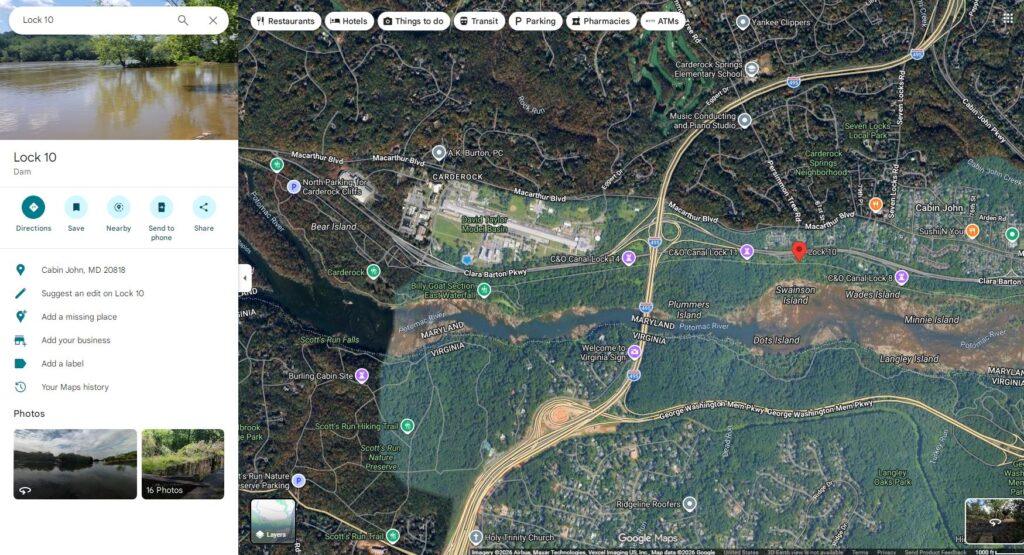
Near Lock 10 on the C&O Canal, Potomac River fully involved by Lock 9.
Assuming you mean Blue Plains Advanced Wastewater Treatment Plant (DC Water’s wastewater plant, not a drinking-water plant): it is operating, while DC Water continues emergency repairs on the upstream Potomac Interceptor collapse. In the latest posted update (Feb 14), DC Water reported no surface-water overflow in the prior 24 hours, three added high-capacity bypass pumps running (fourth pending), and total bypass pumping capacity of 114 million gallons/day (MGD), with some overflow risk still remaining until full repairs are complete. (DC Water)
DOEE’s Feb 13 update says drinking water is safe and not impacted by the sewage release, while advising people to avoid contact with Potomac water during ongoing monitoring. (DoEE)
For historical flow context at Blue Plains:
- 1938 startup era: discharge was reported as less than 100 MGD.
- By 1959 expansion: capacity reached 240 MGD.
- 1970–1983 era: flows were often more than 300 MGD.
- Current plant profile: Blue Plains handles wastewater at an average close to 300 MGD, with design daily average 384 MGD and daily peak handling over 780 MGD. (DC Water)
Using a 30-day month for comparison:
- 900 million gallons/month = 30 MGD
- 100 MGD ≈ 3.0 billion/month
- 240 MGD ≈ 7.2 billion/month
- 300 MGD ≈ 9.0 billion/month
- 384 MGD ≈ 11.52 billion/month (DC Water)
So to your direct question: yes—Blue Plains has clearly been at/above the equivalent of 900 million gallons per month; in fact, that level (30 MGD) is far below the plant’s typical historical operating range. (For added context, the Potomac Interceptor itself is described as carrying up to ~60 MGD, which is ~1.8 billion/month.) (DoEE)
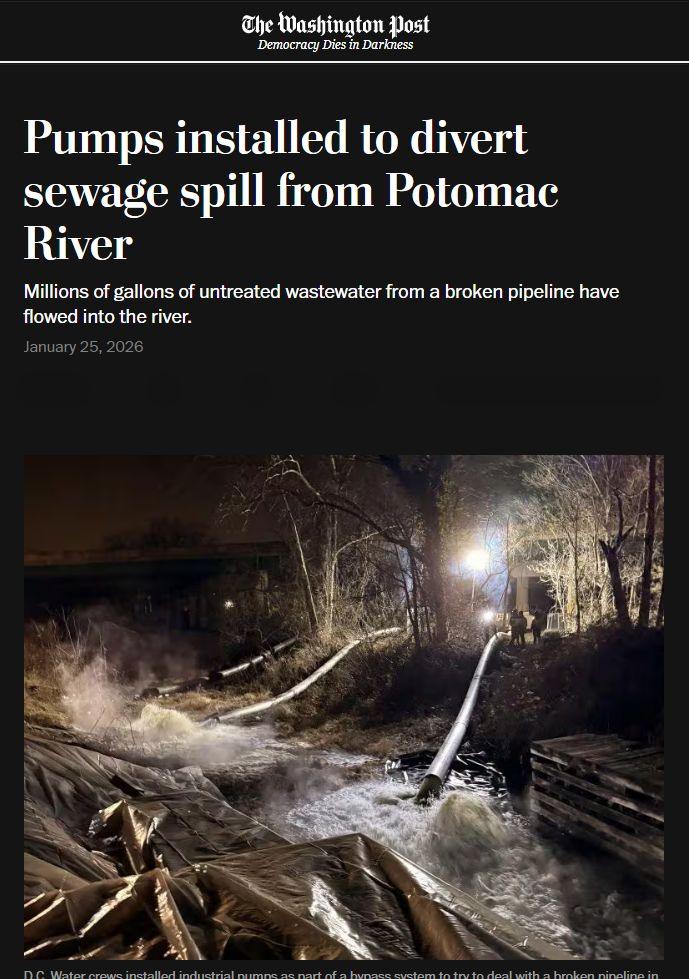
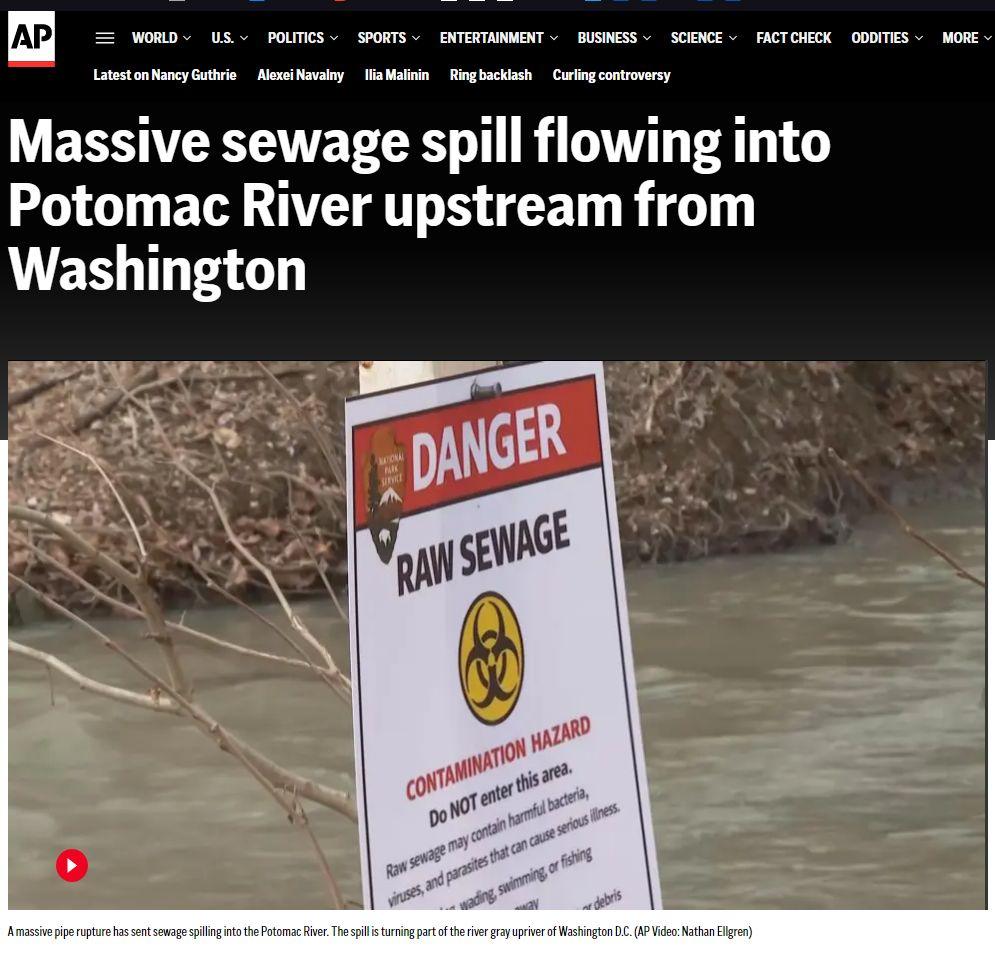
The stench is unbearable: “It lingers on you after you leave,” says D.C. council member Charles Allen, who recently walked the site. https://www.axios.com/local/washington-dc/2026/02/13/sewage-spill-potomac-river-safety-fishing-swimming-future
(Past chat)(Past chat)(Past chat)(Past chat)
If you mean the DC Water Potomac Interceptor (the sanitary sewer system tied to the Potomac corridor), here are the construction/design facts that are documented.
Construction details (confirmed)
- The system was authorized under Public Law 86-515 (June 12, 1960), which authorized planning/construction of the Dulles-to-DC sanitary connection.
- Regional planning documentation states Congress authorized the U.S. Army Corps of Engineers to design and construct the project in 1960, with completion in 1963. (Montgomery County Maryland)
- DC Water describes the interceptor as roughly 54 miles carrying about 60 MGD from the Dulles service area through VA/MD toward Blue Plains. (DC Water)
- A key Potomac crossing segment near Great Falls is documented as about 3,000 ft of 78-inch pipe, about 250 ft below river level, constructed in 1963. (DC Water)
Firm names tied to design/construction work
- Historic planning/design study firm: Burns & McDonnell (1961 planning study cited in project environmental documentation).
- Modern rehabilitation design-build team: Ulliman Schutte + Brown and Caldwell (DC Water-awarded rehab segment; design/engineering/construction scope described publicly). (Brown and Caldwell)
- Emergency PI program contractor (2025 board action): Garney Companies, Inc. for program management, preconstruction, and emergency construction services on PI reliability/rehab.
Design work scope (what the firms were doing)
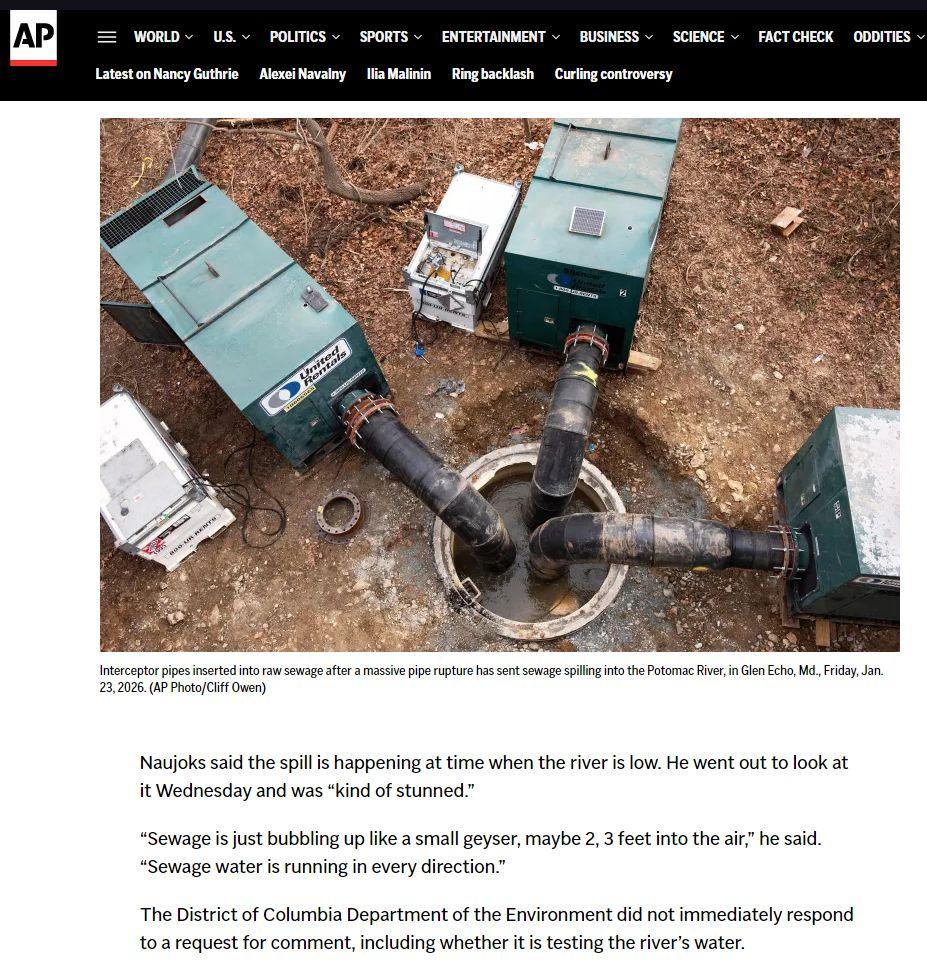
- Progressive design-build rehab included renewal of 54–78 in. pipe sections, deep work, corrosion-control lining, energy dissipation, and temporary bypass/diversion planning to keep flows moving during construction. (Brown and Caldwell)
- 2025 geotechnical design support included rock coring in the Potomac using helicopter-lifted drilling equipment to guide replacement/rehab strategy. (DC Water)
Construction photo sources (official pages with images)
- DC Water drilling-in-river update (Jan 2025) — helicopter/river boring photos. (DC Water)
- DC Water Potomac Interceptor project page — active project imagery (Clara Barton / Great Falls sections).
- “Now Flowing” milestone update (Oct 2025) — completed connection photos.
- Potomac Interceptor collapse/update hub (2026) — ongoing repair and bypass construction photos. (DC Water)
Here are the numbers you’re looking for (for wastewater infrastructure in DC):
- Potomac Interceptor (sewage pipeline): about 60 million gallons per day (MGD), and described as carrying up to 60 MGD. (DC Water)
- Blue Plains Advanced Wastewater Treatment Plant: 384 MGD daily capacity (design/daily capacity), with ability to treat over 780 MGD at peak flow; typical average flow is close to 300 MGD. (DC Water)
As of February 14, 2026, here’s the current picture and the flow math you asked for.
Current status (Blue Plains + Potomac Interceptor)
- Blue Plains (DC Water) is still operating, with DC Water’s current public “at a glance” figure showing an annual average of 294 MGD, design capacity 384 MGD, and peak design capacity >780 MGD. (DC Water)
- The Potomac Interceptor (PI) break (January 2026) caused major overflow; DC Water reported about 243 million gallons overflowed total, with an estimated peak discharge ~40 MGD during the incident period. (DC Water)
- DC Water’s Feb 2026 updates say bypass/repair work is ongoing, with added pumps increasing temporary bypass capability to >100 MGD; a Feb 13 update reported no overflow events impacting surface waters in the prior 24 hours. (DC Water)
Direct answer to your capacity questions
- Potomac Interceptor: DC Water publicly describes it as carrying about 60 million gallons/day from the Dulles-area service region toward DC (then to Blue Plains). (DC Water)
- Potomac Interceptor “capacity” (max nameplate): I do not see a single official maximum hydraulic-capacity number posted in the public pages we pulled; public materials consistently state conveyed flow (~60 MGD) and system dimensions/segments. (DC Water)
- Blue Plains capacity: 384 MGD design, >780 MGD peak design (current DC Water figure). (DC Water)
Was Blue Plains ever 900 million gallons per month?
Yes — by a very large margin.
- Convert threshold:
(900{,}000{,}000 \div 30 = 30{,}000{,}000) gallons/day = 30 MGD. - Blue Plains public averages are in the hundreds of MGD (e.g., 294–320 MGD recent published values), which corresponds to roughly 8.82 to 9.60 billion gallons/month (30-day month). (DC Water)
Historical inflow table (publicly posted figures)
Formula used:
- Gallons/month (30-day approx) = MGD × 30 × 1,000,000
- Gallons/year = MGD × 365 × 1,000,000
| Year / period | Reported flow figure | Approx gallons/month | Approx gallons/year | Public source |
|---|---|---|---|---|
| 1938 era (startup context) | <100 MGD discharge | <3.00 billion | <36.5 billion | DC Water history page (DC Water) |
| 2019 | 320 MGD annual average | 9.60 billion | 116.8 billion | DC Water 2019 Annual Report snippet (DC Water) |
| 2022 | 320 MGD annual average | 9.60 billion | 116.8 billion | DC Water 2022 Annual Report snippet (DC Water) |
| 2024 planning docs | 320 MGD annual average (stated) | 9.60 billion | 116.8 billion | DC Water CIP budget section snippet (DC Water) |
| Current public “at a glance” | 294 MGD annual average | 8.82 billion | 107.31 billion | DC Water At a Glance (DC Water) |
Month-by-month reported snapshots (recent committee materials)
These are useful “historical points” while compiling a full annual series:
| Month referenced in minutes/package | Reported average flow | Approx gallons/month (30-day) | Annualized equivalent |
|---|---|---|---|
| Jan 2024 | 332 MGD | 9.96 billion | 121.18 billion/yr |
| Feb 2024 | 295 MGD | 8.85 billion | 107.68 billion/yr |
| Apr 2024 | 307 MGD | 9.21 billion | 112.06 billion/yr |
| May 2024 | 290 MGD | 8.70 billion | 105.85 billion/yr |
| Aug 2024 | 274 MGD | 8.22 billion | 100.01 billion/yr |
| Oct 2024 | 240 MGD | 7.20 billion | 87.60 billion/yr |
| Dec 2024 | 252 MGD | 7.56 billion | 91.98 billion/yr |
| Mar 2025 | 266 MGD | 7.98 billion | 97.09 billion/yr |
| Apr 2025 | 281 MGD | 8.43 billion | 102.57 billion/yr |
Source basis for rows above: DC Water EQ&O minutes/packages snippets with stated monthly averages. (DC Water)