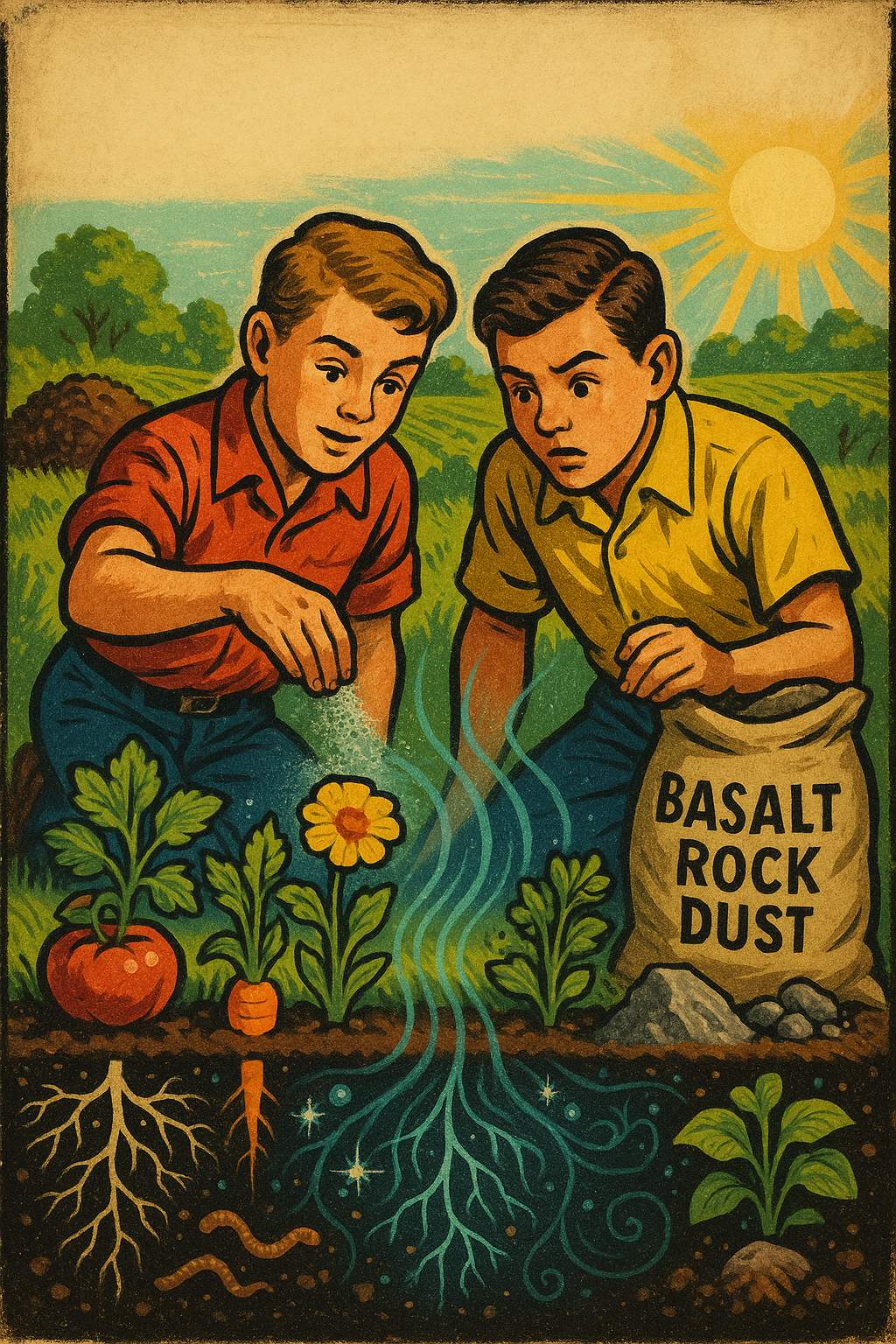
Basalt powder remineralizes soil. Callahan added that basalt’s paramagnetic quality may help soil act less like inert dirt and more like a living energy/mineral system. Whether or not one accepts the full energetic theory, basalt dust is a credible slow-release mineral amendment when paired with living organic soil.
Powdered basalt = finely ground volcanic rock used as a soil mineral amendment.
Core idea:
- Basalt contains slow-release minerals: calcium, magnesium, iron, manganese, potassium, silica, trace elements.
- As it weathers, soil biology and weak acids from roots/microbes break it down.
- It can improve mineral balance, cation exchange, soil structure, and long-term fertility.
- It is not a quick NPK fertilizer; it is more like geologic nutrition for depleted soil.
Philip S. Callahan, PhD, connected basalt/rock dust to a more unusual idea: paramagnetism.
His thesis, simplified:
- Some volcanic rocks, especially basalt, are paramagnetic — weakly attracted to magnetic fields.
- Callahan argued that paramagnetic soils may better interact with Earth/solar electromagnetic energy.
- He believed this could support stronger plant growth, insect resistance, and biological vitality.
- He contrasted this with “dead” or depleted soils lacking mineral/magnetic vitality.
Practical gardener/farmer version:
- Basalt dust may help most where soils are highly weathered, sandy, depleted, acidic, or biologically weak.
- Best used with compost, manure, mulch, humates, mycorrhizae, or active soil biology.
- Typical use is light/moderate broadcasting, not dumping huge amounts.
- It works slowly over months/years.
Cautions:
- Source matters: avoid contaminated quarry dust with heavy metals.
- Very fine dust can be inhalation hazard; wear a mask.
- Don’t expect instant green-up like nitrogen fertilizer.
- Callahan’s paramagnetism theory is influential in alternative/ag circles, but not fully accepted mainstream agronomy.