IEEE 519 is essentially the electric-grid equivalent of a noise ordinance, but it only applies to one of the three known kinds of noise pollution caused by datacenters. Here is an examination of the IEEE519.
IEEE 519 is essentially the electric-grid equivalent of a noise ordinance.
Instead of loud music disturbing your neighbors, it addresses harmonic current distortion injected onto the power grid by nonlinear electrical loads. The goal is that one customer cannot degrade power quality for everyone else connected to the same feeder or substation. IEEE 519 measures distortion at the Point of Common Coupling (PCC) — typically the utility meter or service entrance where the customer’s system meets the utility system. (Eaton)
Electrical Gluttony. Water Consumption. Noise Pollution. Ground Vibration. Powerline Harmonics. Exploring the Web of Land-Grabby, Depopulative, Anti-Meat, Anti-Farm and Anti-Human Incessant Toxic Badness.
Covering every known aspect of Datacenters, including the paranormal.
Sourced Series deeply explores the Many Serious Ill-Effects of Datacenters.
Every statement is sourced by scientific studies, published anecdotes, harmed victims.
Learn from others’ mistakes, or suffer similarly.
“A 2026 power-engineering study found that hyperscale data centers behave not merely as electrical loads, but as vast power-electronics systems whose rapidly fluctuating server demands can excite grid oscillations and propagate disturbances across interconnected networks. Far from a fringe “dirty electricity” claim, the research suggests data centers may interact with the power grid in ways fundamentally different from traditional industrial facilities, raising serious new concerns about resonance, stability, reliability.”
What Harmonic Pollution Actually Is
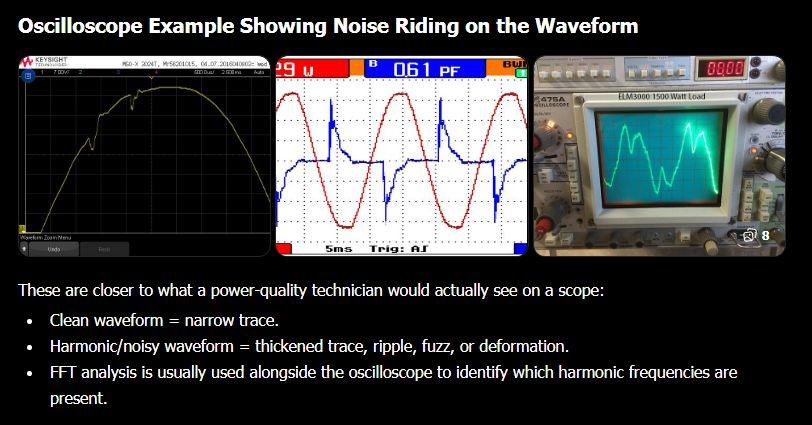
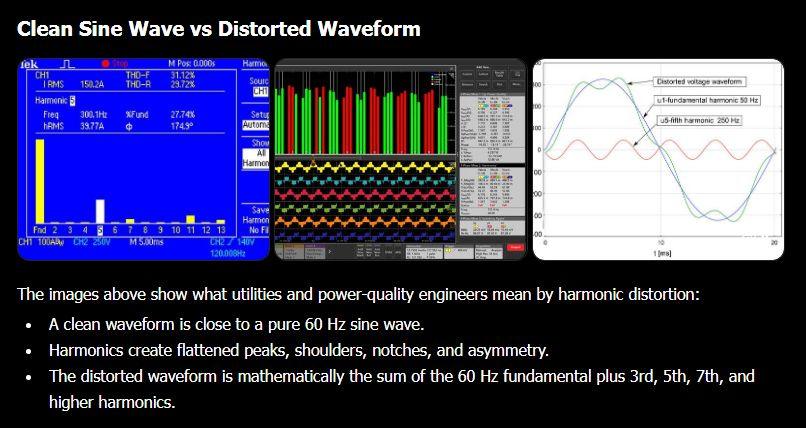
A perfect utility waveform is a 60 Hz sine wave.
Many modern loads do not draw current as a sine wave:
- Switching power supplies
- UPS systems
- Rectifiers
- Variable-frequency drives
- Server power supplies
- GPU clusters
- Battery charging systems
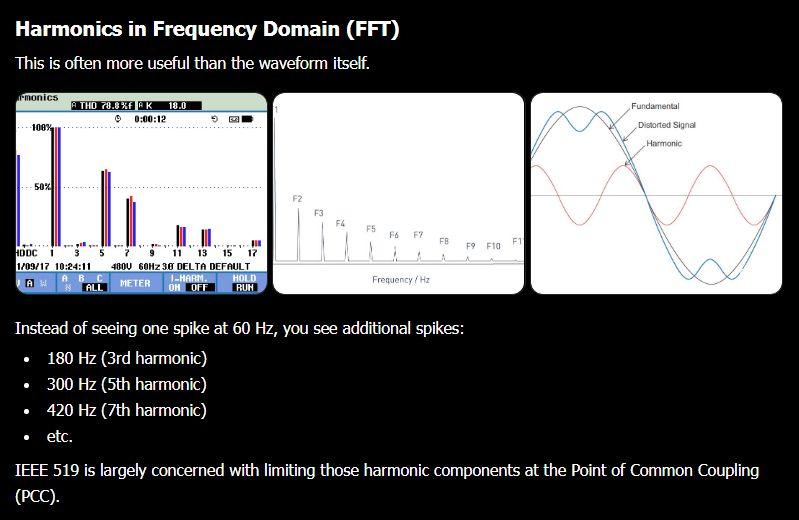
These devices draw current in pulses, creating harmonic frequencies (180 Hz, 300 Hz, 420 Hz, etc.) superimposed on the 60 Hz waveform. (Eaton Videos)
The result can be:
- Transformer overheating
- Neutral conductor overload
- Increased losses
- Nuisance breaker trips
- Voltage distortion affecting neighboring customers
- Utility equipment stress (Dynamic Ratings)
How Utilities Treat Consumers
Utilities generally do not care what harmonics exist inside your building.
They care what reaches the grid.
IEEE 519 limits are measured at the PCC and focus on:
- THD (Total Harmonic Distortion)
- TDD (Total Demand Distortion)
- Voltage distortion limits
- Current distortion limits
The utility becomes the referee ensuring one customer does not pollute the feeder for everyone else. (Eaton)
Large industrial customers are routinely required to:
- Perform harmonic studies
- Install harmonic filters
- Install line reactors
- Use 12-pulse or 18-pulse rectifiers
- Use active harmonic filtering systems
to remain compliant. (Eaton)
How This Applies to Data Centers
Data centers are effectively giant collections of harmonic-generating devices.
Every rack contains:
- Switching power supplies
- UPS systems
- Rectifiers
- DC power conversion equipment
- GPU power supplies
All of these are nonlinear loads. (mtecorp.com)
Historically a 50 MW industrial facility might have contained:
- Motors
- Pumps
- Compressors
which are comparatively benign.
A 50 MW AI data center may contain tens of thousands of switching power supplies operating simultaneously. This creates a completely different harmonic profile. (mtecorp.com)
The industry now recognizes harmonics as one of the major hidden power-quality challenges in modern data centers. Large facilities can significantly affect harmonic distortion on surrounding distribution systems if mitigation is inadequate. (Uptime Institute Blog)
Loudoun County Experience
Loudoun County, Virginia is the world’s largest concentration of data centers and is served primarily by Dominion Energy.
Public discussion there has focused primarily on:
- Grid capacity
- Transmission construction
- Substation proliferation
- Reliability impacts
rather than publicly reported IEEE 519 violations. However, Dominion’s interconnection requirements require power-quality analysis and compliance studies for large customers. Utilities routinely evaluate harmonics, flicker, voltage disturbances, and related power-quality impacts before approving major interconnections. (Dominion Energy)
In practice, hyperscale operators typically deploy:
- K-rated transformers
- Harmonic filters
- Advanced UPS systems
- Active harmonic compensation
because non-compliance would threaten both utility approval and their own uptime. (LinkedIn)
The Montgomery County / Dickerson Question
This becomes interesting with the proposed Dickerson data center developments.
If multiple facilities collectively approach hundreds of megawatts, utilities must evaluate:
- Harmonic current injection
- Voltage distortion at nearby substations
- Resonance effects with capacitor banks
- Transformer derating requirements
- Transmission-level impacts
A 360 MW aggregate load is no longer a “customer”; it begins to behave like a significant grid asset. Harmonic studies would normally be part of the interconnection process. IEEE 519 compliance would generally be expected at the PCC regardless of customer size. (Eaton)
A Frequently Missed Issue
Even when IEEE 519 limits are met, residents can still experience concerns related to:
- Transmission line electromagnetic fields
- Substation magnetic fields
- Audible transformer hum
- Ground potential rise
- Stray currents
- Voltage fluctuations
- Infrasound from cooling equipment
- Piezo-electric tectonic effects
because IEEE 519 addresses harmonic distortion on electrical waveforms, not all possible environmental effects of large electrical infrastructure. A facility can be fully IEEE-519-compliant and still generate other local concerns unrelated to harmonic distortion itself. (Eaton)
The key point is that IEEE 519 was created specifically to prevent one customer from becoming a “power quality polluter” of the shared grid. Data centers, because of their enormous concentration of UPS systems, rectifiers, and switching power supplies, are among the most heavily scrutinized facilities under that framework. (Eaton)