All claims sourced with mainstream / scientific/peer-reviewed papers.
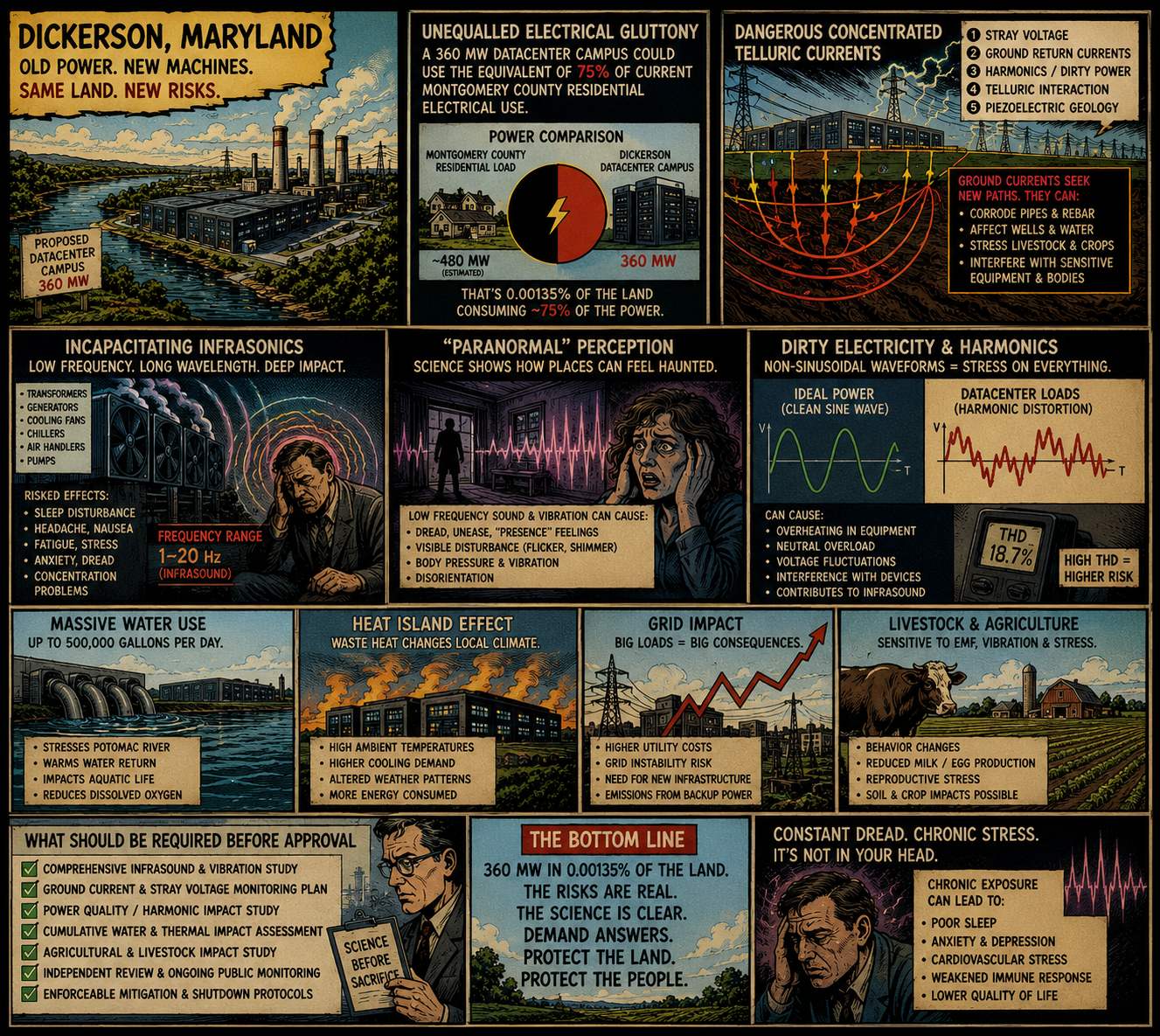
The planned five massive server warehouses would admittedly consume the equivalent of 75% of current county residential electrical use. 360 MW concentrated at one Dickerson site raises legitimate ground-current / power-quality questions, especially in a rural/agricultural setting. A 360 MW data-center cluster is large enough that ground current, stray voltage, harmonic pollution, and dirty-electricity concerns should not be dismissed as fringe. A 360 MW data-center complex could plausibly create a persistent low-frequency acoustic and vibrational environment that ordinary noise rules do not capture. The strongest documented risks are sleep disruption, annoyance, stress, headache, concentration problems, dizziness/nausea in sensitive people, livestock disturbance, and reduced quality of life. The “paranormal” layer is best understood as low-frequency vibration producing dread, visual disturbance, body pressure, and presence-like sensations under certain resonant conditions.
“Just the force-shifting of such massive ground return currents to entirely new areas and telluric paths will be an unprecedented modification of electrical patterns established since formation of the power-grid, building then off-lining of Dickerson electric power generating station, etc. Dramatic effects on crops and livestock may result; new weather patterns / micro-climates have been measured elsewhere; earthquakes/geological events may uptick; quality of water may change; noise pollution is a certainty. This remapping, near-doubling, and then extreme concentration of an additional 75% of the county’s electrical power use into just 0.00135% of its land surface area may turn life in western Montgomery County Maryland on its head and herald the death of Dickerson, demise of Darnestown, and general ‘enshittification’ of life quality in manners yet to be suffered. Those are some ‘sky is falling!’ possibilities, all fully detailed/sourced below, see also https://soundquality.org/2026/05/datacenters-emit-toxic-local-rumble/ and there will likely be more as we are in unknown waters.”
Electrical Gluttony. Water Consumption. Noise Pollution. Ground Vibration. Powerline Harmonics. Exploring the Web of Land-Grabby, Depopulative, Anti-Meat, Anti-Farm and Anti-Human Incessant Toxic Badness.
Covering every known aspect of Datacenters, including the paranormal.
Sourced Series deeply explores the Many Serious Ill-Effects of Datacenters.
Every statement is sourced by scientific studies, published anecdotes, harmed victims.
Learn from others’ mistakes, or suffer similarly.
“A 2026 power-engineering study found that hyperscale data centers behave not merely as electrical loads, but as vast power-electronics systems whose rapidly fluctuating server demands can excite grid oscillations and propagate disturbances across interconnected networks. Far from a fringe “dirty electricity” claim, the research suggests data centers may interact with the power grid in ways fundamentally different from traditional industrial facilities, raising serious new concerns about resonance, stability, reliability.”
Montgomery County’s first proposed hyperscale data center — a 360-megawatt complex planned for the former Dickerson coal plant site — has entered public review, igniting major political and environmental controversy.
The California developer, Atmosphere Data Centers, plans to build five massive server facilities on 110 industrial acres beside the Potomac River, repurposing the old power plant’s transmission infrastructure. The project would consume enormous amounts of electricity and withdraw up to 500,000 gallons of river water per day for cooling.
Supporters frame the project as a reuse of an existing industrial energy site. Critics see it as the opening move in a Northern Virginia–style data center expansion that could reshape rural Montgomery County, strain the electric grid, raise utility costs, increase noise and emissions, and undermine climate goals.
The controversy has become so intense that multiple County Council members are now pushing emergency legislation and even moratoriums to halt or restrict future data center construction before the Dickerson proposal moves forward. [[Evan Glass is calling for a 6 month moratorium and Will Jawando is calling for a 2 year moratorium. Unknown about Andrew Friedson’s position. All three currently serve on the County Council while all three are running for County Executive.]]
Key public hearings begin this summer, with Planning Board review sessions in July and formal zoning hearings scheduled for Sept. 10–11 in Rockville, where residents will be able to testify before the county decides the project’s fate.
See More
https://bethesdamagazine.com/2026/05/23/plans-proposed-dickerson-data-center-online-public
Power Stations in Maryland https://en.wikipedia.org/wiki/List_of_power_stations_in_Maryland
Land-grabbing Galore Elsewhere, under “eminent domain”
- https://www.youtube.com/watch?v=DwzP7X85iL0
- https://www.youtube.com/watch?v=XMNMHf5rHGA
- https://www.youtube.com/watch?v=t-8TDOFqkQA
Unequalled Electrical Gluttony
Massive Electrical Use
Using typical Maryland/Montgomery County residential electricity consumption figures, the proposed 360-megawatt data center cluster in Dickerson would represent an enormous electrical load — roughly comparable to a very large fraction of all residential power consumption in Montgomery County.
Here is the breakdown:
- Typical Maryland household usage:
- ~10,500–11,000 kWh/year (conservative EIA-style estimate) (PriceOfElectricity.com)
- Some Montgomery County estimates are higher, around ~16,500 kWh/year. (EnergySage)
- Montgomery County population:
- ~1.06 million people
- Roughly ~380,000–400,000 households.
Using those numbers:
Estimated Montgomery County Residential Load
Conservative estimate
390,000 homes × 10,560 kWh/year
≈ 4.1 terawatt-hours/year
Average continuous load:
frac{ 4.1 times 10^9 mathrm{ kWh } } { 8760 mathrm{ hours } } approx468 mathrm{ MW }
So residential electricity use countywide is roughly:
- ~470 MW average continuous residential demand
Higher-use estimate
390,000 homes × 16,500 kWh/year
≈ 6.4 terawatt-hours/year
Average load:
frac{ 6.4 times 10^9 mathrm{ kWh } } 8760 mathrm{ hours } } approx730 mathrm{ MW }
So depending on assumptions, Montgomery County residential consumption is probably:
- roughly 470–730 MW average residential load.
Comparison to the Dickerson Data Centers
The proposed Dickerson data center campus is advertised at:
- 360 MW scalable power. (Atmosphere Data Centers)
360 MW continuous equals:
360 mathrm{ MW } times 8760 mathrm{ hours / year } approx 3.15 times 10^9 mathrm{ kWh / year }
That is about:
- 3.15 terawatt-hours/year
- equivalent to roughly:
- ~190,000 Maryland homes using 16,500 kWh/year
- or ~300,000 homes using 10,500 kWh/year.
So the proposed Dickerson complex alone would consume approximately:
- ~50% to ~75% of the entire residential electricity usage of Montgomery County.
That is an extraordinary concentration of electrical demand in a single industrial site.
Some advocacy groups claim the broader Dickerson buildout could eventually approach ~1 gigawatt total demand if all campuses are developed. (Mo-Co Alliance)
For perspective:
- 1 GW continuous load is comparable to:
- a large nuclear reactor output
- or power for roughly 750,000–1,000,000 homes depending on assumptions. (Mo-Co Alliance)
Dangerous Concentrated Telluric Currents
Yes — 360 MW concentrated at one Dickerson site raises legitimate ground-current / power-quality questions, especially in a rural/agricultural setting.
Core issue
A 360 MW data-center load is not just “a lot of power.” It is a large continuous electrical machine tied into transformers, switchgear, grounding grids, neutrals, backup generators, UPS systems, variable-speed drives, rectifiers, inverters, and cooling equipment.
Even with proper engineering, several effects deserve scrutiny:
1. Stray voltage / neutral-to-earth voltage
“Stray voltage” usually means low AC voltage between grounded metal objects and the earth, often discussed on dairy farms. Utility and farm systems are grounded to earth, and some current can flow through earth paths, producing neutral-to-earth voltage. Wisconsin Public Service describes this as neutral-to-earth voltage, and notes that when it appears at animal contact points it is commonly called stray voltage. (Wisconsin Public Service)
This matters because the Dickerson area includes rural land, farms, wells, fences, barns, pipelines, and long conductive paths. Dairy literature has reported cow behavioral effects when neutral-to-earth voltages above roughly 0.7 V create current paths through the animal. (ScienceDirect)
2. Ground return currents
In a perfectly balanced three-phase system, neutral current is low. In reality, large nonlinear loads, imbalance, harmonics, grounding faults, and long feeder systems can push current onto grounding conductors, neutrals, water pipes, fence lines, and earth paths.
For scale:
360 MW at 230 kV transmission voltage is about:
~900 amps per phase
At 34.5 kV distribution/substation voltage:
~6,000 amps per phase
At 13.8 kV medium voltage:
~15,000 amps per phase
So even a tiny leakage, imbalance, harmonic, or grounding error can become meaningful because the base current is enormous.
3. “Dirty electricity”
Samuel Milham’s Dirty Electricity popularized the idea that modern electrification introduced high-frequency voltage transients and harmonics into wiring, with possible biological effects. His argument is controversial, but the electrical phenomenon itself is real: switching power supplies, rectifiers, variable-frequency drives, UPS systems, and inverters all create harmonics/transients unless filtered. Milham’s book frames this as a public-health issue. (Internet Archive)
Data centers are exactly the type of facility that can generate power-quality concerns unless carefully filtered: UPS banks, server power supplies, chillers, pumps, drives, and backup systems.
4. Telluric interaction
Telluric currents are natural or induced currents flowing through the earth. USGS describes telluric methods as using natural earth currents to infer subsurface resistivity. (USGS Publications)
A huge grounded industrial electrical site does not “create natural tellurics,” but it can interact with soil resistivity, groundwater, buried metal, grounding grids, pipelines, fences, and utility neutrals. The key technical question is whether the project’s grounding system causes measurable earth potential rise, neutral-to-earth voltage, or conducted harmonic pollution beyond the property boundary.
5. Piezoelectric geology
Quartz is piezoelectric: mechanical stress can generate charge in quartz-bearing rock. (Wikipedia)
That does not mean a data center automatically activates piezoelectric ground effects. But if the site has quartz-rich bedrock, faulting, blasting, vibration, high ground currents, or changing groundwater chemistry, it is reasonable to ask whether the environmental review has considered subsurface conductivity, rock mineralogy, and induced potentials.
What should be demanded before approval
The county should require a pre-construction and post-construction electrical environment study, including:
- Baseline neutral-to-earth voltage testing on nearby farms, wells, fences, barns, homes, and metal infrastructure.
- Soil resistivity mapping across and around the site.
- Grounding-grid design disclosure and independent review.
- Harmonic analysis from UPS systems, rectifiers, switch-mode loads, chillers, and backup systems.
- EMF and power-quality monitoring at the property boundary.
- Continuous post-startup monitoring for ground current, touch voltage, harmonic distortion, and transient events.
- A complaint-response protocol for livestock, well pumps, fences, shocks, failed electronics, or unexplained animal behavior.
Bottom line
A 360 MW data-center cluster is large enough that ground current, stray voltage, harmonic pollution, and dirty-electricity concerns should not be dismissed as fringe. The correct position is: require measurements, baseline studies, public reporting, and enforceable limits before energizing the site.
Incapacitating Infrasonics and Paranormalcy
Infrasonic / low-frequency risk from a 360 MW data-center campus
The realistic concern is not “sound” in the normal sense. It is continuous low-frequency acoustic pressure plus ground-borne vibration from:
- transformer hum: usually 60 Hz / 120 Hz components
- large cooling fans
- chillers
- pumps
- backup generators
- air handlers
- switchgear
- harmonic vibration from electrical conversion equipment
- possible resonance through soil, foundations, pipes, fences, homes, wells, barns
Low-frequency noise and infrasound are harder to block than ordinary noise. CNRS notes that infrasound below 20 Hz can propagate over great distances. (CNRS News) Leventhall’s review also emphasizes that “below 20 Hz” does not mean harmless or always inaudible; very low frequencies can be perceived as pressure, vibration, or body sensation. (ScienceDirect)
Human effects
The most defensible health concerns are:
- sleep disturbance
- annoyance / agitation
- headache
- concentration difficulty
- fatigue
- nausea / dizziness in some people
- stress response
- reduced quality of life
A systematic review by Baliatsas et al. found associations between low-frequency noise exposure and annoyance, sleep-related problems, concentration difficulties, and headache. (PubMed) WHO also treats environmental noise as a public-health issue tied to annoyance, hypertension, sleep disturbance, tinnitus, cognitive impairment, and mental-health impacts. (World Health Organization)
Taos Hum relevance
The Taos Hum is important because it shows that a low-frequency phenomenon can affect only a minority of people while still being real to them. Reports around Taos involved frequencies roughly 32–80 Hz, and only a small percentage of residents perceived it. (Wikipedia)
That pattern matters for Dickerson: a county noise study using only ordinary A-weighted dBA meters could miss the actual complaint mechanism. Low-frequency noise needs dBC, narrowband FFT, 1/3-octave analysis, and vibration sensors, not just ordinary neighborhood noise readings.
“Paranormal” perception and lab findings
The most cited case is Vic Tandy and Tony Lawrence’s “The Ghost in the Machine.” Tandy traced a haunted-lab experience to an extractor fan producing about 18.98 Hz, near the claimed eye-resonance range; the paper linked that standing wave to anxiety and peripheral visual distortion. (Richard Wiseman)
A later mass experiment exposed roughly 700 people to music containing a near-infrasonic 17 Hz tone; about 22% reported unusual feelings such as unease, sorrow, chills, nervousness, revulsion, or fear. (Wikipedia)
So the clean way to state it is:
Low-frequency vibration can induce sensations that people may interpret as dread, presence, haunting, pressure, visual disturbance, or “something wrong,” especially when the source is hidden and persistent.
That does not require ghosts. It requires resonance, standing waves, stress physiology, and perception under ambiguous sensory conditions.
Benn Jordan / data-center angle
Benn Jordan’s recent video argues that data centers can behave like large acoustic sources and that infrasound near some sites may be affecting residents. His work is not a peer-reviewed epidemiological study, but it is directly relevant as field investigation and public-interest measurement. (youtube.com)
The key value of his work is procedural: go measure the actual low-frequency spectrum near data centers, especially at night, at property lines, in homes, and in the ground.
Livestock / rural impact
Livestock are a serious concern. A 2023 review on sound in livestock farming notes that loud noise can increase anxiety and heart rate, and sudden sound can disturb farrowing and animal behavior. (PMC)
For farms near a major electrical/cooling installation, the relevant questions are:
- Do animals avoid certain barns, waterers, fences, or corners?
- Are milk yield, fertility, sleep/rest behavior, or stress signs changing?
- Are pumps, metal water lines, fences, or stanchions carrying vibration or stray voltage?
- Are low-frequency tones coupling into barns as standing waves?
Telluric vibration
“Telluric vibration” should be treated as ground-borne vibration plus earth-current interaction. Heavy transformers, generators, pumps, and cooling systems can inject vibration into concrete pads and soil. Separately, large grounding grids and neutral currents can create earth-potential effects. When both occur together, nearby metal infrastructure, wells, pipes, fences, and barns may become part of the experienced environment.
What should be required
Before approval or energizing, demand:
- Baseline nighttime low-frequency noise study.
- Infrasound measurements down to at least 1 Hz.
- dBA, dBC, and unweighted spectral data.
- 1/3-octave and narrowband FFT plots.
- Ground vibration monitoring in soil and nearby structures.
- Monitoring at homes, barns, wells, fence lines, and property boundaries.
- Pre/post livestock behavior and production records where farms are nearby.
- Independent public reporting, not consultant-only summaries.
- Enforceable limits for tonal low-frequency noise and vibration, not just average dBA.
Bottom line
A 360 MW data-center complex could plausibly create a persistent low-frequency acoustic and vibrational environment that ordinary noise rules do not capture. The strongest documented risks are sleep disruption, annoyance, stress, headache, concentration problems, dizziness/nausea in sensitive people, livestock disturbance, and reduced quality of life. The “paranormal” layer is best understood as low-frequency vibration producing dread, visual disturbance, body pressure, and presence-like sensations under certain resonant conditions.
See Also
The Power Density vs County Land
- Using the Montgomery Planning staff report for the Dickerson Power Plant/Terra Energy proposal:
- 5 proposed Dickerson data centers: 185,305 sq ft total.
- If you include the associated 5 admin buildings + 5 warehouses in that same land bay: 300,000 sq ft total.
Source: Montgomery Planning report, Land Bay 3. It says five data centers are 185,305 total sq ft, plus admin buildings 77,765 sq ft and warehouses 36,930 sq ft.
- If you include the associated 5 admin buildings + 5 warehouses in that same land bay: 300,000 sq ft total.
- Montgomery County land area: 493.11 square miles.
In square feet:
493.11 × 27,878,400 = 13,747,117,824 sq ft.
Source: U.S. Census QuickFacts. Percentage comparison Data-center buildings only:
185,305 ÷ 13,747,117,824 × 100 = 0.00135% Including admin + warehouse buildings:
300,000 ÷ 13,747,117,824 × 100 = 0.00218% So no — not 0.00001%. It’s about: - 0.00135% if counting only the five data-center building square footage.
- 0.00218% if counting the whole building square footage in Land Bay 3. Important caveat: if you compare land area occupied rather than building floor area, Land Bay 3 is listed as up to 108.94 acres, which is about 0.0345% of Montgomery
County’s land area.
Effects of Extremely Concentrated 360 Megawatts
1) Local water — beyond “they use a lot”
Yes, possible effects include:
- Reduced local water availability if cooling uses potable water or groundwater-heavy supplies.
- Seasonal stress: cooling demand peaks in hot weather/drought.
- Wastewater / blowdown from cooling systems can contain concentrated minerals/chemicals and needs proper treatment.
- Stormwater impacts from large impervious roofs, pavement, grading, and tree removal.
- Indirect water use from electricity generation, especially fossil-fuel or nuclear plants.
For Loudoun County, Virginia, data centers reportedly used around 900 million gallons of water in 2023, and Northern Virginia data centers nearly 2 billion gallons. Loudoun Water also uses reclaimed water from the Broad Run Water Reclamation Facility, which reduces demand on drinking water where connected.
Sources:
EESI https://www.eesi.org/articles/view/data-centers-and-water-consumption
Loudoun Water https://www.loudounwater.org/water-reclamation
WRI https://www.wri.org/insights/us-data-center-growth-impacts
2) Microclimate / heat island
Plausible.
- Data centers reject large amounts of waste heat and often replace vegetation with massive buildings/pavement. A recent preprint on “data heat island” effects estimated ~2°C average land-surface-temperature increase near AI data centers after operation begins, though this is emerging research.
Source: arXiv preprint https://arxiv.org/abs/2603.20897
3) Earthquakes / geological changes
Increased earthquakes ‘from’ data centers: Known human-induced earthquakes are usually linked to things like deep wastewater injection, mining, oil/gas extraction, large reservoirs, geothermal operations, or major groundwater withdrawal — not normal datacenter operation.
Source: USGS induced earthquakes overview
https://www.usgs.gov/programs/earthquake-hazards/science/induced-earthquakes-overview
Possible non-earthquake geological/hydrological changes:
- land grading and compaction,
- erosion,
- altered runoff,
- lowered groundwater only if major local groundwater extraction occurs.
4) Paranormal activity
Increased reports could happen socially because:
- constant hum,
- low-frequency vibration,
- sleep disruption,
- stress,
- industrial lighting,
- anxiety about rapid landscape change.
Those can make a place feel subjectively “off”, eerie, unwelcoming, etc.
5) Livestock
Plausible. Livestock can be affected by:
- continuous noise,
- vibration,
- construction disturbance,
- lighting,
- heat,
- water/access changes,
- loss of pasture.
A review on sound and livestock notes that harmful noise effects are reported and that chronic noise stress is often overlooked, though more research is needed.
Source: PMC livestock sound review https://pmc.ncbi.nlm.nih.gov/articles/PMC10376870/
6) Constant dread / unease
This is plausible as a human health / nuisance effect, especially from 24/7 low-frequency hum, vibration, sleep disruption, and visual intrusion. Virginia’s JLARC report found residents near data centers described migraines, disrupted sleep, trouble concentrating, and poorer quality of life from constant noise.
Source: Virginia JLARC report PDF https://jlarc.virginia.gov/pdfs/reports/Rpt598.pdf
Sources, grouped by claim:
Loudoun / Virginia data-center noise & resident effects
- Virginia JLARC, “Data Centers in Virginia” report
Relevant lines: data-center noise complaints, constant “drone/hum,” Loudoun/Fairfax complaint data, residents reporting migraines, disrupted sleep, concentration problems, poorer quality of life.
https://jlarc.virginia.gov/pdfs/reports/Rpt598.pdf
Water use / water impacts
- Environmental and Energy Study Institute — Data Centers and Water Consumption
Cites Northern Virginia data centers using nearly 2 billion gallons in 2023, Loudoun around 900 million gallons, plus indirect water use from power generation and chip manufacturing.
https://www.eesi.org/articles/view/data-centers-and-water-consumption - EPA — Stormwater / impervious surfaces
Large roofs, pavement, compacted land, etc. increase runoff and can carry pollutants into waterways.
https://www.epa.gov/npdes/npdes-stormwater-program
https://www.epa.gov/sourcewaterprotection/urbanization-and-stormwater-runoff
Microclimate / heat-island effects
- EPA — What Are Heat Islands?
Explains how buildings, roads, reduced vegetation, and waste heat create hotter local conditions.
https://www.epa.gov/heatislands/what-are-heat-islands - arXiv preprint — “The data heat island effect: quantifying the impact of AI data centers in a warming world”
Emerging research estimating average ~2°C land-surface temperature increase near AI data centers after operation — preliminary/preprint.
https://arxiv.org/abs/2603.20897
Earthquakes / geological change
- USGS — Injection-induced earthquakes
Human-induced earthquakes are linked to deep fluid injection, mining, reservoirs, oil/gas extraction, groundwater/fluid withdrawal — not ordinary data-center operation.
https://www.usgs.gov/publications/injection-induced-earthquakes
Noise, dread, sleep, health
- WHO — Environmental noise guidance
Noise can cause annoyance, sleep disturbance, cardiovascular effects, cognitive impacts, etc.
https://www.who.int/tools/compendium-on-health-and-environment/environmental-noise - Systematic review — Low-frequency noise and health effects
Found associations between low-frequency noise exposure and annoyance, sleep problems, concentration difficulty, headaches.
https://pubmed.ncbi.nlm.nih.gov/26994804/
Livestock
- Review — “The Role of Sound in Livestock Farming—Selected Aspects”
Notes prolonged noise can be an overlooked chronic stressor in animals.
https://pmc.ncbi.nlm.nih.gov/articles/PMC10376870/ - “Noise as a factor of environmental stress for cattle – A review” Cattle-specific review.
https://sciendo.com/article/10.2478/aoas-2023-0046
Paranormal activity
A supported explanation for “weird” perceptions is environmental stress: constant hum, vibration, low-frequency noise, sleep disruption, lighting, and anxiety about industrial change.
Regarding “Paranormalcy”
Yes — there are sources for the “felt dread / weird perception” —
- Supported environmental nuisance / neurophysiological plausibility
- Speculative or not directly proven for data centers
Strongest data-center-specific source
Virginia JLARC, Data Centers in Virginia, 2024
This is the best official Virginia source. It says data centers emit low-frequency noise, that A-weighted ordinances often miss it, and that residents near some facilities reported migraines, disrupted sleep, concentration problems, and poorer quality of life.
Source: https://jlarc.virginia.gov/pdfs/reports/Rpt598.pdf
Relevant sections: Chapter 6, Local Residential Impacts; especially pages around 75–86.
Infrasound / “paranormal” / dread sources
Steven T. Parsons, “Infrasound and the Paranormal,” Journal of the Society for Psychical Research, 2012
This is directly on point. It discusses the Tandy/Lawrence 19 Hz hypothesis, anomalous experiences, feelings of foreboding, dread, anxiety, nausea, and how infrasound may be misinterpreted as paranormal.
Source PDF:
https://www.sgha.net/library/INFRASOUND.pdf
This evidences how low-frequency/infrasonic environments can produce sensations that people may interpret as “paranormal”.
Tandy & Lawrence, “The Ghost in the Machine,” 1998
Classic “19 Hz” paper tying a defective fan / standing wave to apparent haunting sensations. Often cited in the infrasound-paranormal literature. Discussed xtensively in Parsons above.
PDF: https://capitanache.com/assets/pdf/Tandy-The-Ghost-in-Machine.pdf
Citation: Tandy, V., & Lawrence, T. R. (1998). The Ghost in the Machine. Journal of the Society for Psychical Research, 62(851), April 1998.
Key details from the paper:
- It describes a 19 Hz standing air wave as a possible natural cause of some “haunting” experiences.
- The source was traced to an extractor fan.
- Reported effects included discomfort, depression, cold shivers, feeling watched, fear, and a peripheral “apparition.”
- They recommend investigators rule out low-frequency sound/infrasound in haunting or poltergeist-type cases.
Low-frequency noise health effects
World Health Organization — Environmental noise
WHO recognizes environmental noise as a health issue, especially through sleep disturbance, annoyance, stress, and cardiovascular effects.
Source:
https://www.who.int/europe/health-topics/noise
Review: Low-frequency noise and health
A review on low-frequency noise reports links with annoyance, sleep problems, headaches, and concentration issues.
PubMed:
https://pubmed.ncbi.nlm.nih.gov/26994804/
Electromagnetics / mood / perception / brain effects
WHO — Electromagnetic fields
WHO explains the basic mechanism: higher voltage produces stronger electric fields; greater current produces stronger magnetic fields. It also says sufficiently large induced currents can stimulate nerves/muscles.
Source:
https://www.who.int/news-room/questions-and-answers/item/radiation-electromagnetic-fields
WHO — Electromagnetic hypersensitivity
Source:
Review: ELF-EMF biological effects
This review covers extremely-low-frequency electromagnetic fields and experimental biological effects, including nervous-system-related pathways. Useful for showing there is scientific literature.
Source:
https://www.frontiersin.org/journals/neuroscience/articles/10.3389/fnins.2023.1247021/full
Livestock / ground currents / stray voltage
This is the strongest “electrical effects on animals” category.
Merck Veterinary Manual
Stray Voltage in Animal Housing Very relevant. It states cattle can show behavioral responses to low milliamp currents, especially around waterers, milking parlors, wet floors, metal structures, grounding problems, etc.
Source:
Key point: livestock effects are well established for contact voltage / stray voltage, not vague “EMF vibes.” This is measured with cow-contact voltage/current testing.
USDA / Agriculture Handbook No. 696
Cited by Merck. Covers how to detect and remedy electrical voltage/current problems in farm animals.
PDF:
https://docs.idahopower.com/pdfs/Safety/StrayVoltageBooklet.pdf
Stray Currents in Livestock Farming Review/discussion of stray current diagnosis on farms.
Source:
https://www.mdpi.com/2077-0472/13/10/2010
Cattle magnetic alignment / power lines
“Extremely low-frequency electromagnetic fields disrupt magnetic alignment of ruminants”
This paper found high-voltage power lines disrupted cattle/deer magnetic alignment behavior.
Source:
https://pmc.ncbi.nlm.nih.gov/articles/PMC2667019/
Bottom line —
- Data centers can produce constant low-frequency noise that ordinary dB(A) rules may miss.
- Virginia’s own JLARC report says some residents report migraines, sleep disruption, poor concentration, and reduced quality of life near noisy data centers.
- Infrasound/low-frequency sound literature includes reports of foreboding, anxiety, dread, nausea, vertigo, pressure sensations, and anomalous/paranormal interpretations.
- EMF effects on humans are more contested; WHO does not confirm ordinary low-level EMF as a cause of symptoms.
- Livestock effects from stray voltage / ground current are real and measurable, especially at water/feed/milking contact points.
Given the incredible scale of power infrastructure, low-frequency acoustic emissions, and possible stray-current pathways, these effects should be measured directly rather than dismissed.
See also