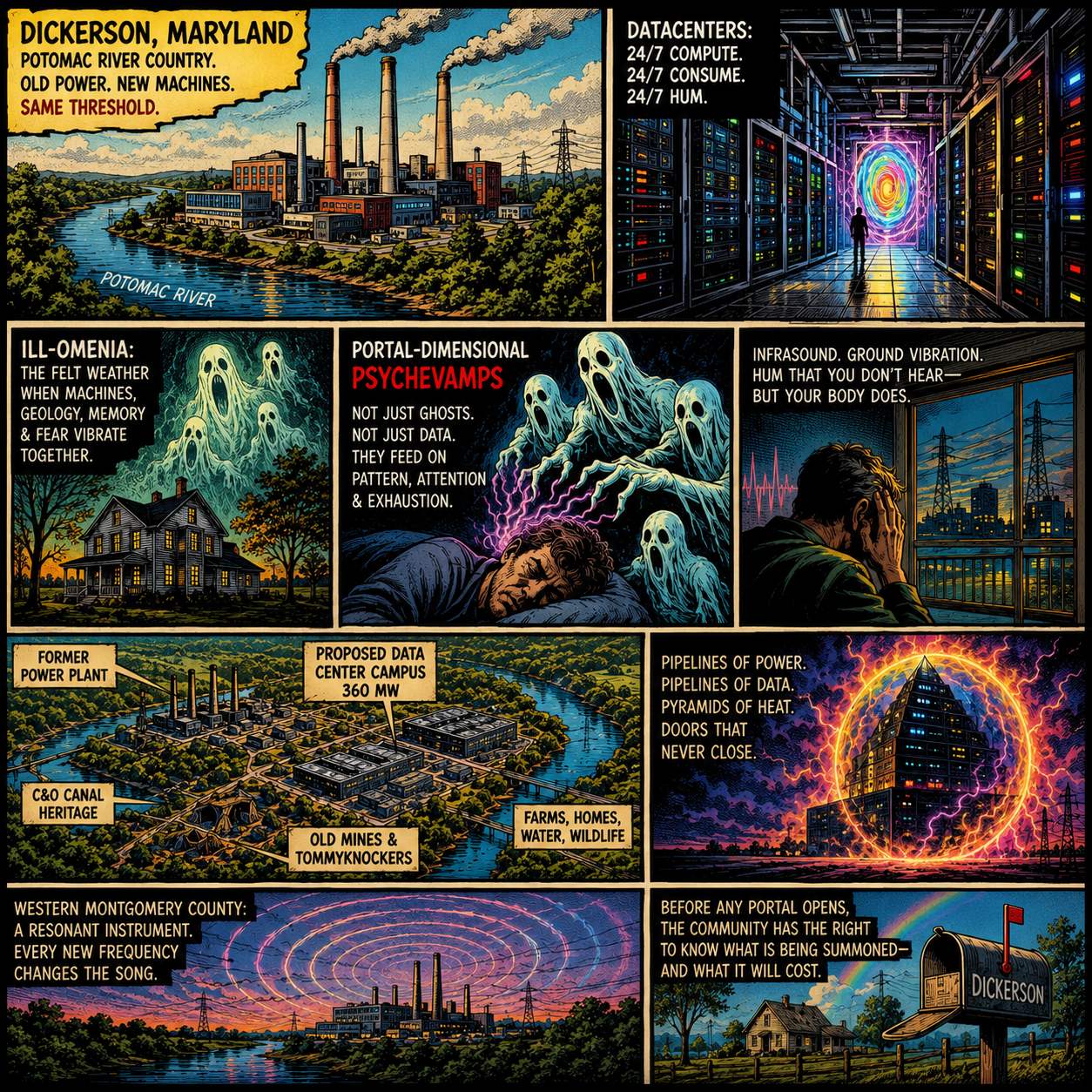
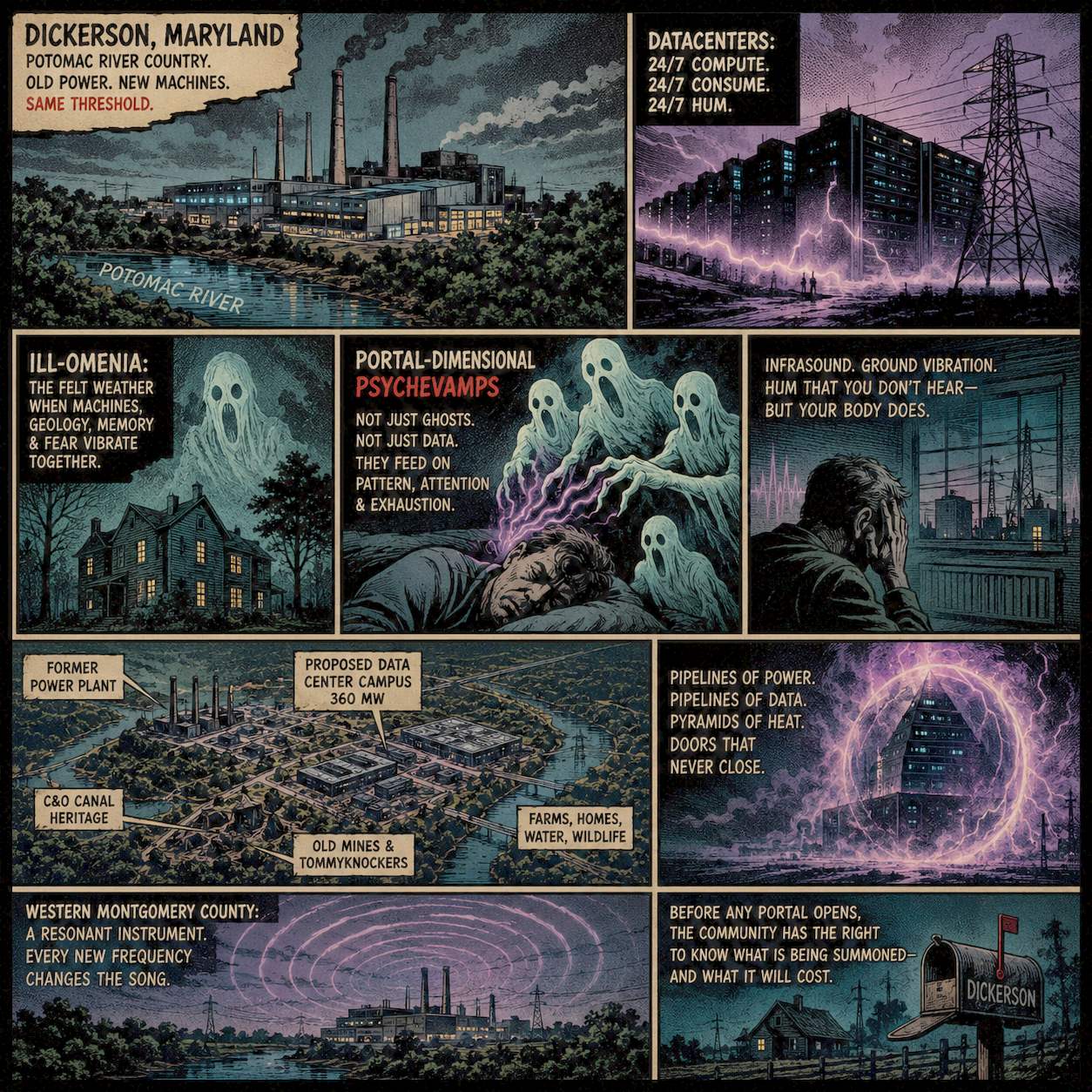
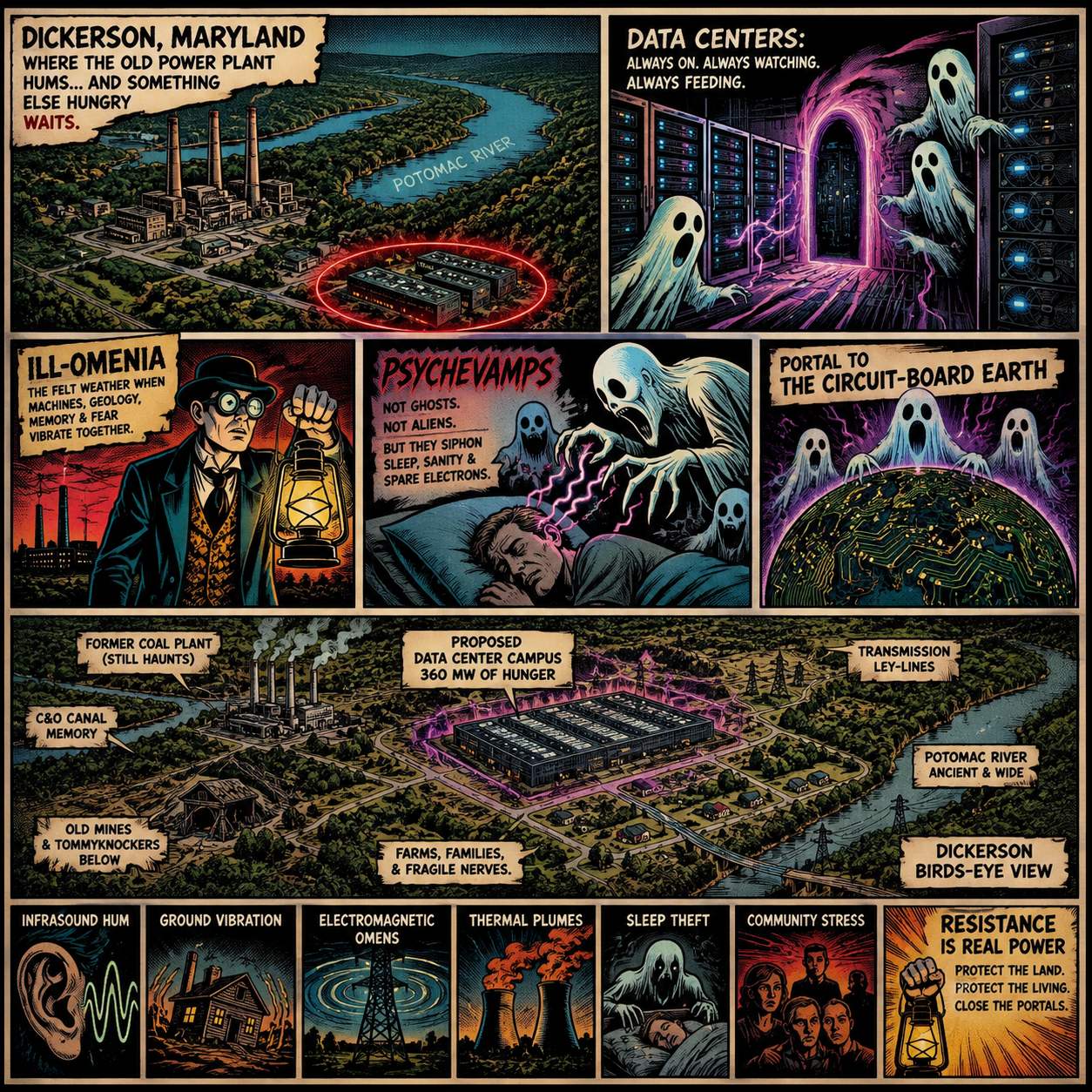
Exploring potential psy/para aspects — Could dreadful Tommyknockers spread due to datacenters? Consider Michelle Gibson’s considerable esoteric research into “circuit-board earth”.
“What datacenters will do is sicken the residents, make the area unliveable, and then destroy any inherent resale value beyond that of scrap-land for eventual government takeover.”
Table of Contents
- The New Machine at the Old Threshold
- The Scientific Haunting
- The Ghost in the Machine
- The 19 Hz Chapel
- The Hum Comes to Dickerson
- Telluric Anxiety
- The Broken Grid Hypothesis
- From Free Current to Captive Current
- Canals, Railroads, Lighthouses, and the Potomac Circuit
- Data Centers as Artificial Ley-Line Parasites
- Bedrock, Water, Wells, and the Lithophone County
- Cymatics of the Agricultural Reserve
- Schumann Resonance and Hostile Rhythm
- Dramamine for the Demon
- Subterranean Sickness and Machine Time
- Gallaudet and the Architecture of Vibration
- The Anti-Bell
- Musical Entrainment and Captured Nervous Systems
- Dan Winter and Destructive Interference
- Star Forts, Ley Lines, and Algorithmic Geometry
- Animals as Early Warning Instruments
- Tommyknockers Beneath the Machine
- Ill-Omenia: A Necessary New Word
- What Should Be Required Before Any Portal Opens
- The Final Warning Knock
- Sources
———
The New Machine at the Old Threshold
The proposed Dickerson data-center complex is not merely a land-use dispute. It is the proposed insertion of a vast, continuous electrical organism into one of western Montgomery County’s oldest psychic landscapes: Potomac River stone, C&O Canal memory, former coal-power infrastructure, agricultural ground, old mines, buried water, quartz veins, transmission corridors, war-shadow, and tommyknocker lore.
Atmosphere Data Centers markets its Dickerson project as a future Tier III+ data center site with 360 MW of scalable power, 170 acres zoned for heavy industrial use, backup generators, UPS systems, redundant power, cooling infrastructure, and AI/cloud readiness. The company also advertises direct proximity to major data-center hubs and multiple fiber routes. In ordinary development language, this is “infrastructure.” In older language, it is a summoning circle made of transformers, fiber, chilled air, diesel reserves, and uptime guarantees. Atmosphere Data Centers (https://atmosphere-dc.com/data-centers/dickerson-md/)
Local concern is already intense. WTOP/Bethesda Today reported in May 2026 that Montgomery County Councilmember Evan Glass introduced legislation to temporarily halt data-center permits, citing resident concern over environmental impacts from future data centers, including the 360 MW Dickerson proposal at the former coal-fired power-plant site. WTOP (https://wtop.com/montgomery-county/2026/05/the-urgency-is-real-glass-introduces-bill-to-halt-data-centerpermits-in-montgomery-county/)
A conventional article would stop there: power demand, water use, diesel generators, zoning, emissions, grid strain, noise, and land-use compatibility.
All real.
But Dickerson deserves a deeper reading.
Because a data center is not just a warehouse. It is an artificial nervous system. It is a sealed computational monastery. It eats electricity, exhales heat, mutters in fans, pulses through transformers, vibrates through slabs, drinks air or water for cooling, roams cyberspace, and hallucinates in silicon.
It is a building designed to host invisible intelligences: corporate models, military simulations, financial predictions, synthetic voices, surveillance archives, machine vision, language engines, biometric ghosts.
In another century, people feared mills, mines, furnaces, and railroads as places where the underworld came close to the surface.
In this century, the underworld hums at 60 Hz.
The Scientific Haunting
The strongest paranormal concern around large data centers is not that they summon spirits in a cartoon sense. It is that they may generate physical conditions historically associated with haunting experiences.
Low-frequency noise and infrasound are peculiar. They are often not heard as ordinary sound. They are felt as pressure, vibration, unease, nausea, fatigue, dread, or the sense that something is present. They pass through walls more readily than higher-frequency sound. They can couple into buildings, pipes, windows, barns, wells, fences, ducts, cavities, concrete pads, and bedrock in ways that ordinary A-weighted noise measurements may miss.
That matters because the human being is not merely an ear. The human being is a resonant animal.
A person lying in bed at 2:40 a.m. does not experience a 24/7 industrial hum as a zoning abstraction. The body experiences it as invasion. The old mammalian alarm system asks:
- Is there thunder?
- A predator?
- A distant engine?
- A collapse?
- A presence?
- Why is the floor faintly alive?
The original Dickerson data-center article sharply identifies the danger: not merely audible noise, but persistent low-frequency acoustic pressure plus ground-borne vibration from transformers, cooling fans, chillers, pumps, backup generators, switchgear, UPS systems, rectifiers, inverters, and other electrical-conversion equipment.
Dangerous Dickerson Datacenters
(https://wp.darnestown.net/2026/05/dangerous-dickerson-datacenters/)
This is where the scientific haunting begins. A data center does not need to open a Hollywood portal. It may only need to create the conditions under which the mind begins supplying the portal.
The Ghost in the Machine
One of the most famous bridges between haunting and physics is Vic Tandy and Tony Lawrence’s “Ghost in the Machine” case. Tandy worked in a laboratory with a reputation for eerie phenomena and traced sensations of dread, unease, and visual disturbance to a low-frequency standing wave near the edge of human hearing.
The point is not that infrasound disproves ghosts. The point is worse.
Infrasound describes the atmospheric conditions under which ghosts become plausible.
Below roughly 20 Hz, sound becomes less like ordinary noise and more like pressure, tremor, intrusion. It may arrive as dread, nausea, fatigue, eye strain, anxiety, chest pressure, disturbed sleep, or the conviction that something unseen has entered the room.
A data center is full of possible generators for such effects: transformers, cooling fans, chillers, pumps, diesel backup generators, electrical rooms, air-handling systems, ductwork, battery systems, and hard industrial surfaces capable of creating standing waves.
A single fan is one thing. A campus-scale array of synchronized or near-synchronized machinery is another.
Multiple machines can ‘beat’ against one another, producing slow pulses and modulations — a
mechanical ‘breathing’. A hum becomes a throb. A throb becomes a knock. A knock becomes a code. A code becomes a presence. This is where the “ghost in the machine” ceases to be metaphor. A machine can generate the subjective architecture of haunting.
Environmental psychology has already begun to treat haunted-house reports as serious interactions between people and surroundings. A 2020 Frontiers in Psychology review identified recurring environmental variables in haunt-type experiences, including lighting, air quality, temperature, infrasound, electromagnetic fields, and holistic environment-person interactions.
Frontiers in Psychology
(https://www.frontiersin.org/journals/psychology/articles/10.3389/fpsyg.2020.01328/full)
That is exactly the Dickerson question. Not: “Are ghosts real?” But: “Can a massive industrial machine create the environmental grammar of haunting?” Yes.
The 19 Hertz Chapel
A low-frequency standing wave turns a room into an instrument.
At certain frequencies, walls do not merely reflect sound. They participate. Air columns pulse. Sheet metal flexes. Windows tremble. Human organs and sensory systems become part of the circuit.
A 19 Hz wave is not heard so much as inhabited. It teaches the eye to mistrust the corner. It makes still air seem occupied. It presses on the body without offering a visible source.
This is why ordinary sound limits are not enough.
The legal noise world often relies on dBA measurements, which discount low-frequency energy because they are modeled around average human hearing sensitivity. But the uncanny does not obey dBA. The body may perceive low-frequency pressure as vibration, vestibular disturbance, or anxiety long before the ear names it sound.
The data-center question is therefore not simply: Will it be loud?
It is:
- Will it make houses resonate?
- Will bedrooms become pressure chambers?
- Will barns become drums?
- Will wells, pipes, fences, ducts, and bedrock carry the signal farther than the air model
- predicts?
An haunted house is often a resonant house.
Dickerson deserves to know whether it is being asked to host a 360 MW haunting engine.
The Hum Comes to Dickerson
There are places in the world where people report a persistent, maddening low-frequency hum: Taos, Bristol, Kokomo, Windsor, Auckland, Largs, and other towns where only some residents hear or feel the intrusion.
“The Hum” is rarely described as ordinary noise. It is a distant diesel engine that never arrives. A refrigerator in the walls. A generator under the earth. A vibration that becomes stronger indoors, at night, or in bed.
Some people do not perceive it at all.
Others find it unbearable.
This selectivity makes the phenomenon easy to dismiss. But selective perception is not proof of imagination. Bodies differ. Houses differ. Foundations differ. Bedrooms differ. Age, hearing range, bone conduction, vestibular sensitivity, stress, illness, sleep deprivation, and building resonance all matter.
Sometimes the Hum is mysterious.
Sometimes the Hum is industrial.
The horror is that both experiences feel the same at 3 a.m.
If Dickerson becomes host to a large data-center campus, the fear is that western Montgomery County may acquire its own version: the Potomac Hum — a low-frequency trespass moving through night air, soil, bedrock, barns, wells, and nervous systems.
Telluric Anxiety: When Ground Becomes Circuit
The Dickerson article’s most interesting esoteric-scientific thread concerns telluric currents, stray voltage, neutral-to-earth voltage, harmonic pollution, dirty electricity, and ground-current pathways.
Telluric currents are real natural earth currents. Industrial grounding systems do not create the earth’s natural electrical life, but large electrical installations can interact with soil resistivity, buried metal, grounding grids, water lines, fences, pipelines, wells, and utility neutrals.
In rural settings, this matters because farms are full of long conductors: wire fences, waterers, barns, pumps, gates, stanchions, metal roofs, buried pipes.
This is where science begins to sound like folklore, because old folklore was often a crude phenomenology of place. People did not have spectrum analyzers, but they knew when a barn “felt wrong.” They did not have power-quality monitors, but they knew when animals would not cross a threshold.
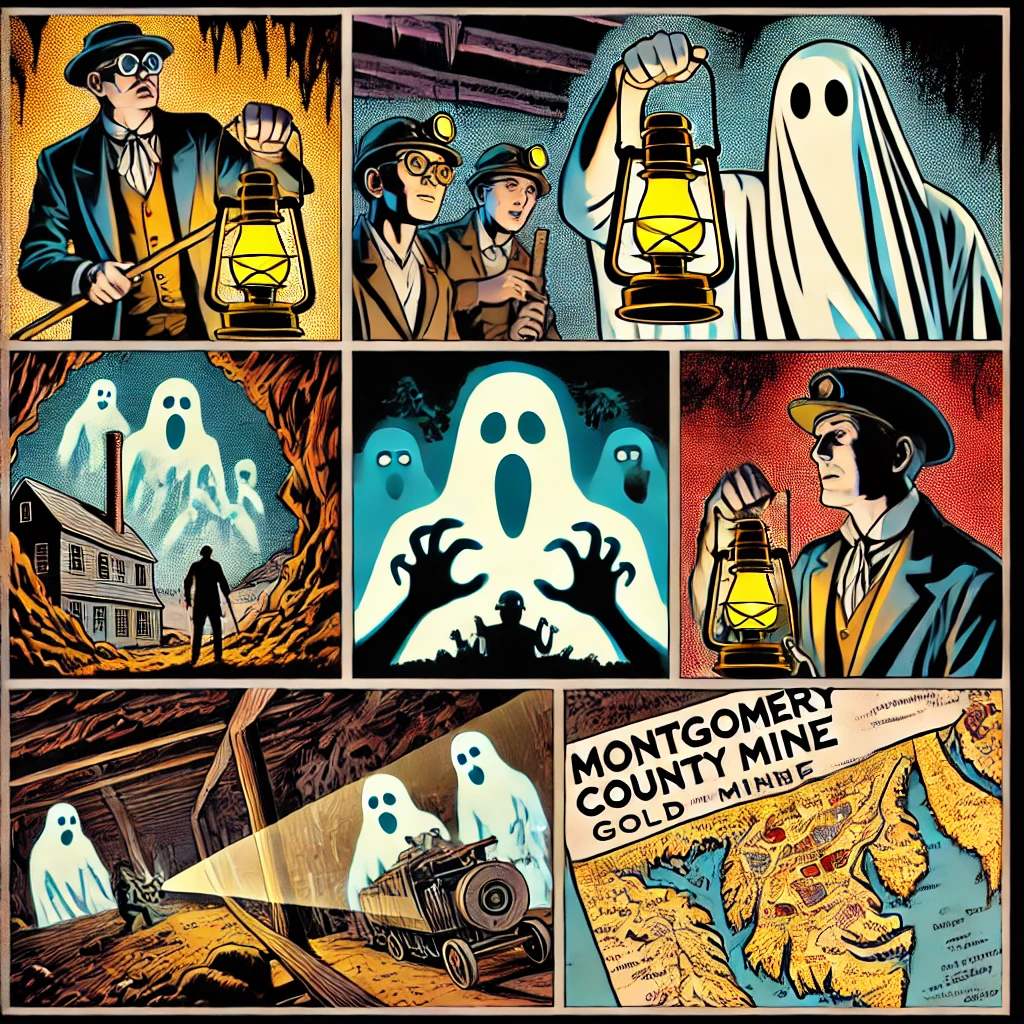
The Maryland gold-mine tommyknocker story contains exactly this kind of sign. After the 1906 Maryland Mine explosion near Great Falls, local lore says a horse refused to enter the property gates, rearing and pawing at the air. Soon came footsteps, knocks, fiery eyes, a ghostly figure crawling from the shaft, and the feeling that something beneath the ground had not settled.
EastGhost
(https://wp.eastghost.com/2025/01/tommyknockers-and-maryland-gold-mines/)
Today we might ask different questions:
- Was there unstable ground?
- Gas?
- Subsonic movement?
- Shifting timbers?
- Water in shafts?
- Metallic resonance?
- Trauma memory?
- Human fear amplified by darkness?
But the older reading is not stupid. It is poetic compression:
The ground was warning them.
Now place that warning beside Dickerson.
What happens when a former coal-power landscape is reactivated not by fire and steam, but by computation, harmonic loads, transformers, battery systems, cooling arrays, and backup generators?
What happens when the ground is asked to become stable host for a machine that never sleeps?
The official answer will be engineering.
The local answer may be dreams.
The Broken Grid Hypothesis
There is another, stranger lens through which to view Dickerson — not as accepted geology or academic history, but as esoteric cartography.
In Michelle Gibson’s extensively-researched “broken free-energy grid” thesis (hundreds of video hours, sourced evidence), the modern industrial world was not built entirely from scratch by heroic engineers with picks, shovels, mule teams, and sudden genius. Instead, she suggests that much of what we call modern infrastructure may have been adapted from, or laid over, remnants of an older terrestrial energy system: canals, rail corridors, lighthouses, mines, locks, tunnels, waterfalls, power canals, stoneworks, and straight-line routes across difficult landscapes.
Michelle Gibson video
(https://www.youtube.com/watch?v=jQ2EVeXv5Lc)
In that worldview, the Earth once functioned like a vast circuit board. Waterfalls, rivers, mineral deposits, rail alignments, towers, lighthouses, and monumental masonry acted as conductive, resonant, or distribution elements. Then came a catastrophic disruption — a buckling, undulating, drowning, burying, shearing of the old grid — after which the emerging industrial order excavated, repurposed, monetized, and finally abandoned pieces of the former system.
Coal, oil, iron, steel, railroads, canals, locks, and power plants became replacement technologies: ontrollable, billable, centralized, and owned.
Again: this is not conventional history. But as mythic operating system, it is potent, and it brings us directly back to Dickerson. Because Dickerson is not isolated. It sits within one of the great American energy corridors: the Potomac, the C&O Canal, the B&O Railroad, Point of Rocks, former coal power, quarry and mining country, transmission lines, river crossings, agricultural reserve, and the western Montgomery County edge where the metropolitan grid meets older earth.
The C&O Canal and B&O Railroad famously broke ground on the same day — July 4, 1828 — and competed for the Potomac corridor. In ordinary history, this is transportation rivalry. In esoteric history, it looks like a struggle over a line of force: water-road versus iron-road, canal current versus rail current, mule path versus metal conductor.
The proposed Dickerson data centers would be the next layer in that succession:
- River.
- Canal.
- Railroad.
- Coal plant.
- Transmission grid.
- Artificial-intelligence compute complex.
Each age insists it is only improving infrastructure.
Each age says the same spell:
- Progress.
- Efficiency.
- Jobs.
- Power.
- Inevitability.
But the land may hear something else.
It may hear another attempt to plug into the old board.
From Free Current to Captive Current
The broken-grid thesis is useful not because one must accept every claim literally, but because it asks the right occult-industrial question: Who controls the current?
The older dream of “free energy” is not merely about electricity without a bill. It is about a world in which energy belongs to the landscape, sky, water, stone, and people — not to monopolies, financiers, extraction empires, or server-farm landlords.
The industrial age converted living currents into captive currents.
- Coal became metered heat.
- Oil became metered motion.
- Rail became controlled corridor.
- Waterfalls became hydroelectric capital.
- Rivers became canals.
- Canals became ruins.
- Rail beds became trails.
- Power plants became brownfield opportunities.
And now, with data centers, electricity itself becomes cognition-for-rent.
The Dickerson proposal is therefore not just a new use for an old power site. It is a symbolic culmination: the coal plant reborn as a temple of computation.
The furnace becomes the server.
The smokestack becomes the fiber line.
The turbine hall becomes the machine mind.
If one accepts even a poetic version of the broken-grid hypothesis, then Dickerson becomes dangerous in a different way. The fear is not only that data centers will consume too much power. The fear is that they will misuse a node.
They will reawaken an old corridor without understanding its older intelligence.
Canals, Railroads, Lighthouses, and the Potomac Circuit
Gibson’s transcript dwells on canals, railroads, mines, locks, lighthouses, ore docks, waterfalls, and power canals across Pennsylvania, Appalachia, the Great Lakes, and the C&O/B&O corridor. Her recurring pattern is this:
A difficult landscape receives astonishing infrastructure very quickly. The infrastructure is tied to mining, coal, iron, oil, canals, locks, or rail. It becomes obsolete, abandoned, demolished, flooded, or repurposed. Powerful industrial families and financiers consolidate control. The public is told this is simply progress. That pattern resonates sharply in Maryland’s Montgomery County.
The C&O Canal itself is a ribbon of stone, water, lock, towpath, and ruin following the Potomac’s geomantic edge. The Paw Paw Tunnel, built through a mountain bend, feels less like a mere utility and more like a ritual incision. Point of Rocks, where canal and railroad fought for passage, is practically an altar of American infrastructure conflict.
Then, farther downriver and nearby in Montgomery County, the Maryland gold mines add another layer: shafts, quartz, hidden mineralization, buried labor, death, explosion, rumor, tommyknockers.
In the broken-grid imagination, gold mines are not just places where men searched for metal. They are places where the earth’s conductive nerves were exposed. Quartz, gold, water, pressure, darkness, and human greed formed a psychophysical apparatus. The tommyknocker was not merely a ghost of the mine. He was the sound of the circuit protesting.
Knock.
Knock.
Knock. Not here.
Not deeper.
Not this way.
Datacenters as Artificial Ley-Line Parasites
A datacenter is, in one sense, a parasite on the electrical grid. That sounds harsh, but technically it is accurate. A datacenter does not generate food, shelter, water, or local resilience. It attaches to power capacity and converts it into remote computational service. Its gains or benefits are often abstract and distant, but its burdens are immediate and local.
In an esoteric reading, such a facility behaves like an artificial ley-line parasite. It seeks:
- massive electrical feed;
- stable ground;
- fiber connectivity;
- water or cooling capacity;
- security perimeter;
- distance from public scrutiny;
- proximity to transmission infrastructure;
- political permission.
Those are not unlike the requirements of a ritual engine.
- The machine must be placed at a node.
- The node must be energized.
- The energy must be stabilized.
- The output must be transmitted elsewhere.
- The local population must be told not to worry.
If the old Potomac corridor is already a wounded circuit — river, canal, rail, coal, gold, transmission — then a 360 MW data center does not merely “locate” there. It clamps onto the wound.
This is where paranormal language becomes useful. A bad project does not have to summon demons. It can behave demonically by draining a place while speaking in the language of optimization.
Bedrock, Water, Wells, and the Lithophone County
Low-frequency vibration is not only air. It can be structure-borne and ground-borne.
Western Montgomery County has bedrock, old mine geology, quartz associations, wells, masonry, barns, fences, pipes, culverts, and the Potomac corridor. It is not empty land. It is a resonant body with scars.
The question is not only what the data center emits into the air.
The question is what the ground chooses to conduct.
Foundations can couple vibration into houses. Pipes can become conductors. Metal fences can tremble. Wells can carry sound. Barn floors can resonate. Ducts can become organ pipes. Old shafts and voids can become listening tubes.
The spooky / haunted old mine stories and lore become less quaint when viewed acoustically.
A knock in the earth may be superstition.
Or timber stress. Water movement. Metallic resonance. Gas. Grief. Warning.
Maybe it is that the tommyknocker exists exactly where those categories overlap.
Cymatics of the Agricultural Reserve
Cymatics shows that vibration creates form.
On Chladni plates, sand gathers into geometric figures when a plate vibrates. In Faraday-wave experiments, liquids form ordered patterns under oscillation. Matter is not passive under frequency. It organizes, clusters, empties, knots, and blooms.
A Scientific Reports paper on flexural vibrations notes the long history of Hooke-Chladni-Faraday visualization: when a resonant plate is excited, powder collects along nodal lines, making standing waves visible.
Scientific Reports
(https://www.nature.com/articles/srep23929)
This is not occultism. It is physics. But, it gives occultism its best visual metaphor.
If a violin plate can draw sigils from vibration, what patterns might a 360 MW industrial machine draw invisibly through soil, sleep, animal behavior, water, and community emotion?
The Agricultural Reserve is already patterned: fields, hedgerows, old roads, streams, stone boundaries, ridges, churches, cemeteries, barns, and the Potomac corridor.
A data center imposes a different geometry: rectangles, substations, fenced perimeters, ducts, conduits, fiber routes, cooling arrays, transmission feeds, surveillance lines.
This is cymatics at landscape scale — not because sand will form mandalas in Dickerson fields, but because imposed vibration reorganizes behavior.
Birds shift.
People close windows.
Sleep moves to another room.
Horses avoid a corner.
A farmer stops using a barn at night.
A family begins to dread the hour when the hum thickens.
The pattern appears first in avoidance. Then in complaint logs. Then in real-estate decisions. Then in folklore.
Schumann Resonance and Hostile Rhythm
The Earth already hums.
The Schumann resonance is an electromagnetic resonance of the Earth-ionosphere cavity, with a fundamental commonly cited near 7.83 Hz and higher harmonics.
It is planetary electrodynamics: lightning, atmosphere, ionosphere, global cavity.
Many extravagant wellness claims have been attached to it. Some are doubtful. But the poetic fact remains: the planet has rhythms, and life evolved inside them.
The issue is not vibration itself. The issue is hostile vibration. Human beings live among nested rhythms: heartbeat, breath, sleep cycles, circadian light, lunar tide, seasonal growth, birdsong, insect pulse, church bells, weather fronts, farm work, river levels.
Industrial systems impose other rhythms: shift schedules, engines, compressors, traffic, alarms, HVAC, substations, server fans, notification pings, algorithmic refresh cycles.
Ill-omenia begins when machine rhythm overwhelms creature rhythm.
A data center does not sleep. It does not listen for dawn. It does not rest on Sunday. It does not grow tired of its own hum. It does not know breeding season, lambing, harvest, mourning, or prayer. It simply continues. That continuity is part of the harm.
Dramamine for the Demon
Motion sickness is one of the most useful scientific analogies for modern haunting.
The body becomes nauseated when sensory systems disagree. The eyes say the room is still. The inner ear says the body is moving. The brain receives incompatible signals and produces dizziness, sweat, dread, fatigue, and nausea.
A medical review describes motion sickness as a normal physiological response to real or virtual motion stimuli, often triggered by low-frequency motion affecting the vestibular system.
PMC Motion Sickness Review
(https://pmc.ncbi.nlm.nih.gov/articles/PMC7048153/)
Low-frequency industrial vibration can create a similar uncanny mismatch.
The house appears still, but the body detects micromotion.
The bed seems solid, but the sleeper’s vestibular system receives faint rhythmic disturbance.
The visual field says: nothing is happening.
The bones, gut, and inner ear say otherwise.
That conflict is profoundly destabilizing.
Dramamine is not an anti-ghost medicine, but it treats one of haunting’s cousins: the nausea of invisible motion.
A data center that produces persistent low-frequency vibration, tonal beating, or ground-borne tremor could create a landscape of subtle vestibular irritation. Not enough to look dramatic. Enough to degrade sleep. Enough to make people feel “off.” Enough to make a room feel wrong.
Fatigue follows. Then irritability. Then anxiety. Then the old language returns: Oppression. Presence. Bad energy. A curse on the place.
Science may call it low-frequency exposure. Folklore calls it a haunting. The body knows it as ill-omenia.
Subterranean Sickness and Machine Time
Human beings are solar animals. We are governed by dawn, dusk, horizon, season, weather, and social rhythm.
Remove those cues and consciousness changes.
Underground and sealed environments have repeatedly shown this. Cave-isolation studies, bunker experiments, basement laboratories, windowless institutions, submarines, mines, prisons, and underground military facilities all disturb the ordinary architecture of time.
The 1938 Mammoth Cave sleep study by Nathaniel Kleitman and Bruce Richardson investigated how absence of the natural light-dark cycle affected wakefulness, body temperature, mental performance, and biological rhythms. The National Park Service describes the study as foundational for later sleep science.
National Park Service
(https://www.nps.gov/articles/000/dreaming-underground-the-mammoth-cave-sleep-study.htm)
A Frontiers review on underground spaces notes recurring psychosocial concerns: isolation, reduced perceived control, negative cultural associations, lack of natural light, wayfinding difficulty, and uneasiness or claustrophobic reactions.
Frontiers in Psychology
(https://www.frontiersin.org/journals/psychology/articles/10.3389/fpsyg.2017.00452/full)
Data centers are not prisons for humans. They are bunkers for non-human thought. But they bring bunker logic above ground: windowless enclosure, artificial light, restricted access, permanent cooling, security perimeter, surveillance, machine time, no dawn, no dusk, no Sabbath.
The danger is not that Dickerson residents will be placed underground. The danger is that underground conditions will rise around them: mechanical air, sealed time, constant hum, artificial rhythm, and a facility that never sleeps and therefore inescapably entrains the neighborhood to never sleep.
Coal plants at least had the ancient honesty of fire. Data centers are colder, stranger, more monastic. They are sealed temples of machine cognition. Their god is uptime.
Gallaudet and the Architecture of Vibration
Gallaudet University’s DeafSpace principles reveal something environmental regulators often forget: buildings are not merely heard. They are felt.
Gallaudet describes DeafSpace as an architectural approach shaped by deaf experience, including sensory reach, visual awareness, acoustics, light, proximity, and tactile cues. The university specifically notes that deaf people may read surroundings through visual and tactile cues including vibrations and subtle movement.
Gallaudet University
(https://gallaudet.edu/campus-design-facilities/campus-design-and-planning/deafspace/)
That insight should transform how Montgomery County thinks about data-center impact.
Vibration is not simply “noise below hearing.” It is bodily communication.
It enters through skin, bones, floors, furniture, water lines, foundations, barns, and animals. A hearing-centered noise ordinance may fail to protect people from the very effects most likely to become disturbing.
A true review would measure what houses feel. Not only dBA at the property line, but low-frequency spectra indoors at night. Bedframe vibration. Barn-floor vibration. Window resonance. Well-pipe vibration. Fence-line conduction. Transformer harmonics. Ground-borne tremor.
If data-center vibration enters a home through the floor rather than the ear, the resident may not say:
“I hear noise.”
They may say:
I feel watched. I feel pressure. The house feels alive. The animals won’t settle. I wake up afraid and do not know why.
That is not hysteria. It is embodied perception looking for language.
The Anti-Bell Church bells once organized time.
They rang for worship, noon, danger, death, wedding, fire, war, curfew, mourning, and feast. They were loud, but meaningful. They entered the body as public signal. Their authority was communal, ceremonial, and finite.
Even bells can disturb sleep. An ETH Zurich-indexed study examined awakening reactions from nocturnal church-bell noise using polysomnography and event-related analysis.
ETH Zurich
(https://www.research-collection.ethz.ch/entities/publication/ea3a785d-d5f2-4b6c-846d-7f3ce0b0c5d6)
But the bell at least has meaning.
A bell rings, then releases silence.
A data center hums and abolishes silence.
The bell says: remember.
The server says: process.
The bell marks human time.
The server enforces machine time.
The bell gathers a village.
The server extracts from a planet.
This is not nostalgia. It is acoustic sovereignty. Communities once had sounds that belonged to them. Now they increasingly endure sounds imposed upon them by systems that do not answer to local meaning.
The anti-bell does not call the living to gather. It keeps the living slightly awake.
Musical Entrainment and Captured Nervous Systems
Sound organizes people.
Rhythm synchronizes walking, chanting, marching, dancing, praying, rowing, breathing, and labor. Music can alter mood, attention, arousal, memory, and group identity. Repetition can soothe or dominate. Drums can heal. Drums can command.
This is the legitimate scientific core behind stranger claims about music, cult control, brainwave entrainment, military sound, and frequency manipulation.
Some fringe theories — including claims around Solfeggio frequencies, 528 Hz, or Leonard Horowitz’s DNA-repair assertions — reach far beyond accepted evidence. But even when the details are dubious, the anxiety is not absurd.
Modern people are saturated with imposed rhythms: engines, HVAC, alerts, fans, traffic, sirens, refrigeration, turbines, fluorescent buzz, server hum.
The nervous system is no longer left alone.
A data center adds another layer to that saturation: not music, not speech, not alarm, but continuous mechanical entrainment without message. That may be the most sinister sound of all.
A chant can be resisted because it has words. A machine hum enters below argument.
Dan Winter and Destructive Interference
In Dan Winter’s esoteric electrical cosmology, healthy energy is fractal, recursive, phase-coherent, implosive — a nesting of waves capable of compression without violence.
Conventional science does not accept much of Winter’s framework as established physics.
But as a metaphor for place, it is useful.
A living landscape is not silent. It is coherent in its complexity.
Birds, insects, wind, water, hoof, rain, leaf, frog, owl, tractor, bell, and thunder all enter and leave. Their rhythms overlap but do not usually tyrannize. They create a breathing acoustic ecology.
Bad infrastructure is different. It does not sing with place. It beats against it.
Ill-omenia can be understood as destructive interference between landscape rhythm and machine rhythm.
The old pattern is not erased at once. It is jammed. Sleep is jammed. Animal rest is jammed. Human intuition is jammed. Memory is jammed. The result is not silence. It is bad resonance.
Star Forts, Ley Lines, and Algorithmic Geometry
Power arranges itself geometrically.
Star forts, capitals, canals, railroads, boulevards, survey grids, transmission corridors, pipelines, fiber routes, and server campuses all reveal the same impulse: to impose abstract order upon living terrain.
Whether one sees star forts as military architecture, geomantic instruments, or both, they teach a crucial lesson:
Geometry is never neutral when backed by power.
The data center is the star fort of the algorithmic age.
It has perimeter, enclosure, security, hidden command, inward-facing function, and outward- projecting influence. It does not need cannon. Its weapons are uptime, computation, dependency, and secrecy.
A ley line may be folklore. A transmission corridor is a ley line with lawyers. A fiber route is a ley line with latency requirements. A data center is a node where invisible lines converge and depart: electricity, capital, cloud contracts, surveillance, artificial intelligence, emergency generators, tax incentives, land speculation, political pressure.
The old geomancers placed temples where earth and sky were thought to meet.
The new geomancers place server farms where cheap land, power capacity, water, fiber, and political weakness meet.
That is not less magical. It is only less honest.
Animals as Early Warning Instruments
The EastGhost tommyknocker lore includes the horse refusing the Maryland Mine gate after the fatal 1906 explosion. That image matters.
Animals are often the first witnesses in haunted landscapes because animals do not explain away what they feel.
Horses notice ground tremor. Cattle notice stray voltage. Dogs notice pressure shifts and tones humans ignore. Birds depend on acoustic habitat. Bees and insects live in vibration-sensitive worlds. Livestock respond to disturbance long before a consultant writes a report.
The original Dickerson article correctly points toward livestock as a serious rural concern. Noise, vibration, electrical leakage, harmonic pollution, and stray voltage are not abstract on farms. They may appear as animals avoiding waterers, refusing barns, reduced rest, agitation, altered feeding, reproductive stress, or unexplained behavioral change.
The paranormal version says: Animals sense ghosts.
The scientific version says: Animals perceive environmental disturbance differently than humans.
The wiser version says: Those may be the same warning written in two languages.
If the horses refuse Dickerson’s new gate, will the county call it folklore? Or will it finally measure the ground?
Tommyknockers Beneath the Machine
The tommyknocker is not a generic ghost. It is a mining spirit — a knocker in the dark. In Cornish and Appalachian traditions, the knocking could be warning, mischief, omen, or the sound of dead miners continuing their work underground.
Maryland has its own Montgomery County variant. EastGhost collects lore around the Maryland Mine near Great Falls, where gold mining began after Civil War-era discoveries and continued intermittently into the 20th century. Montgomery County once had numerous small gold-mining operations. The local tommyknocker legend intensified after the fatal 1906 explosion that killed miner Charles Eglin. Reports followed: footsteps, knocks, fiery eyes, EMF spikes, drained batteries, a horse refusing the gate, and a lingering sense that the mine had acquired an “energy.”
EastGhost
(https://wp.eastghost.com/2025/01/tommyknockers-and-maryland-gold-mines/)
Whether one believes any of that literally is secondary.
The tommyknocker is the spirit of extraction. It appears when humans cut into the earth for wealth and awaken consequences. It knocks before collapse. It warns that the seam is unstable. It is the conscience of the shaft.
This is where the data center becomes uncanny. It is not mining gold from quartz. It is mining value from computation. It is not extracting ore. It extracts power, water, land, silence, darkness, attention, and local tolerance.
The old gold mines chased flecks in rock. The new compute mines chase flecks of predictive advantage in data. And Stephen King’s The Tommyknockers hovers over the whole scene like an accidental prophecy: a buried technological force infecting a town, amplifying intelligence while degrading judgment, turning ordinary people into servants of a hidden machine.
King’s version is science-fiction horror. But its symbolic fit is almost too neat. A community discovers that something under the ground is broadcasting influence. People become more capable and less sane. Technology accelerates while morality corrodes.
No one should claim that Dickerson’s servers will psychically possess Poolesville. But it is fair to ask: What kind of mind does a county develop when it gives its quiet places to machines whose purpose is to accelerate machine intelligence?
Ill-Omenia: A Necessary New Word
We need a word for the total condition. Not pollution alone. Not haunting alone. Not anxiety alone. Not infrastructure alone.
Ill-omenia: the environmental, psychic, and social atmosphere produced when a place begins emitting bad signs.
Ill-omenia is what residents feel before measurable harm is acknowledged. It is the headache before the study. The animal agitation before the report. The bad sleep before the ordinance update. The “something is wrong” before the consultant says all standards were met.
Ill-omenia is not proof. It is not data. But it is often the human sensorium noticing a pattern before institutions have categories for it.
A community can suffer ill-omenia from:
- low-frequency hum;
- tonal vibration;
- disrupted sleep;
- industrial night lighting;
- loss of darkness;
- cooling heat;
- electrical transients;
- fear of water depletion;
- livestock unease;
- visual domination by blank buildings;
- distrust of developers;
- grief over landscape change;
- buried histories resurfacing.
In a haunted landscape, ill-omenia becomes the medium through which old stories return.
A single sound can annoy. A continuous sound can colonize. A knock once is a branch. A knock every night at 3:12 becomes a visitor. A low hum once is machinery. A low hum that follows you into sleep becomes a curse. A flicker once is bad wiring. A flicker during a dream of dead miners becomes communication.
This does not mean the interpretation is objectively supernatural. It means the human nervous system is built to search for agency in patterns, especially under stress, darkness, fatigue, and ambiguous sensory input.
Thus a bad data-center environment could manufacture hauntings without producing a single ghost.
Or, if one is more esoterically inclined, it could thin the membrane.
What Should Be Required Before Any Portal Opens
If Montgomery County is going to entertain this project, the review must not be limited to ordinary noise and ordinary engineering assurances.
The county should require a full ill-omenia audit — in plain terms, a rigorous pre/post study of environmental conditions most likely to produce dread, disturbance, and haunting-like effects.
At minimum:
- Baseline low-frequency noise monitoring before construction, including nighttime readings.
- Infrasound measurement down to at least 1 Hz, not merely ordinary dBA.
- dBA, dBC, and unweighted spectral reporting.
- Narrowband FFT and 1/3-octave analysis.
- Ground-vibration monitoring at homes, barns, wells, fences, and property boundaries.
- Transformer and cooling-system tonal analysis, including worst-case night conditions.
- Power-quality and harmonic studies involving UPS systems, rectifiers, inverters, drives,
and backup systems. - Neutral-to-earth voltage and stray-voltage testing on nearby farms and conductive
structures. - Soil-resistivity mapping and grounding-grid review.
- Vibrotactile measurements in homes and barns.
- Livestock behavior baselines for cattle, horses, poultry, and other sensitive animals.
- Dark-sky and light-trespass limits.
- Thermal-plume and local heat-island analysis.
- Continuous public monitoring dashboards.
- Complaint-triggered independent investigation with enforceable mitigation.
- A cultural-landscape review including canal, rail, mining, agricultural, Indigenous, and
historical context.
The county should not laugh at residents who describe dread, pressure, hum, insomnia, or animal unease. Those are not paranormal complaints. They are often the first subjective forms of measurable disturbance.
The Final Warning Knock
The Potomac is not scenery. It is the region’s long nerve.
The river corridor carries history, weather, stone, memory, commerce, war, canal engineering, Indigenous displacement, industrial ambition, and recreational forgetting. Alongside it run old alignments: towpath, rail, road, transmission, fiber, jurisdictional boundary, mythic boundary.
Waterways have always been portals because they conduct more than water. They conduct settlement, goods, rumor, disease, soldiers, fugitives, coal, timber, ghosts.
A data center beside this corridor is not just near infrastructure. It is near a nervous system. All computation becomes heat. Every AI inference, every generated image, every synthetic voice, every financial model, every surveillance query, every cloud transaction, every invisible calculation eventually degrades into waste heat.
A datacenter is a furnace pretending to be a brain.
Coal plants burned ancient sunlight and made heat.
Data centers burn grid electricity and make heat. The old industrial world mined carbon from the underworld. The new industrial world mines pattern from human behavior.
Both require sacrifice zones.
This is where all the evidence converges: infrasound, hum, motion sickness, cymatics, Schumann resonance, bells, bunkers, ley lines, tommyknockers, bedrock, ghost machinery.
The proposed Dickerson data centers may not open a portal in the cartoon sense. They may do something more plausible and more frightening.
They may complete a circuit.
River to canal.
Canal to rail.
Rail to coal.
Coal to grid.
Grid to server.
Server to artificial mind.
Artificial mind to human dependency.
Human dependency back into the machine.
A loop. A spell. A closed circuit of extraction.
The tommyknocker is not anti-technology. He is anti-arrogance. He does not say: never dig. He says: listen before collapse.
An haunted place is not always a place with ghosts. Sometimes it is a place where the living can no longer rest.
If the county proceeds without deep measurement, enforceable limits, and humility toward western Montgomery County’s land-memory, then the first knock may not come from a miner’s ghost under Great Falls.
It may come from the walls of a farmhouse near Dickerson at 3 a.m.
A pulse.
A tremor.
A hum beneath hearing.
And then the new word will spread: Ill-omenia. The bad omen made atmospheric. The ghost in the grid. Not all grids should be reawakened. Not all currents should be captured. Not all deathly machines should be placed nearby online.
———
Sources
- Dangerous Dickerson Datacenters, wp Darnestown:
https://wp.darnestown.net/2026/05/dangerous-dickerson-datacenters/ - Atmosphere Data Centers, Dickerson MD: https://atmosphere-dc.com/data-centers/dickerson-md/
- WTOP / Bethesda Today on Montgomery County data-center moratorium: https://wtop.com/montgomery-county/2026/05/the-urgency-is-real-glass-introduces-bill-to-halt-data-center-permits-in-montgomery-county/
- Montgomery Planning staff report, Dickerson Power Plant / Terra Energy: https://montgomeryplanningboard.org/wp-content/uploads/2024/08/Dickerson-Power-Plant_Terra-Energy-Staff-Report-Final-2.pdf
- Tommyknockers of Maryland Gold Mines, EastGhost:
https://wp.eastghost.com/2025/01/tommyknockers-and-maryland-gold-mines/ - Michelle Gibson, “circuit-board earth” / broken energy-grid thesis:
https://www.youtube.com/watch?v=jQ2EVeXv5Lc - Tandy & Lawrence, “The Ghost in the Machine”:
https://capitanache.com/assets/pdf/Tandy-The-Ghost-in-Machine.pdf - Steven T. Parsons, “Infrasound and the Paranormal”: https://www.semanticscholar.org/paper/INFRASOUND-AND-THE-PARANORMAL-Parsons/65f834ca8cd434c07e0975efaa44a94eae011c44
- Frontiers, environmental appraisal of haunted houses:
https://www.frontiersin.org/journals/psychology/articles/10.3389/fpsyg.2020.01328/full - Cymatics / Chladni / flexural vibration paper: https://www.nature.com/articles/srep23929
- Motion sickness review: https://pmc.ncbi.nlm.nih.gov/articles/PMC7048153/
- Underground spaces psychology review:
https://www.frontiersin.org/journals/psychology/articles/10.3389/fpsyg.2017.00452/full - Mammoth Cave sleep study, National Park Service:
https://www.nps.gov/articles/000/dreaming-underground-the-mammoth-cave-sleep-study.htm - Gallaudet DeafSpace:
https://gallaudet.edu/campus-design-facilities/campus-design-and-planning/deafspace/ - Church bells and nocturnal awakening, ETH Zurich: https://www.research-collection.ethz.ch/entities/publication/ea3a785d-d5f2-4b6c-846d-7f3ce0b0c5d6
- Low-frequency noise health review: https://pubmed.ncbi.nlm.nih.gov/26994804/
- Underground spaces psychology review:
https://www.frontiersin.org/journals/psychology/articles/10.3389/fpsyg.2017.00452/full - Stanford Prison Experiment background: https://www.zimbardo.com/prison.htm
- Urban low-frequency noise measurement: https://www.nature.com/articles/s41370-023-00599-x